

A Simpler Time: How We Used to Absorb Information
There was a time when the American public received nearly all its news and information through a few trusted sources: the nightly news, the morning paper, and the occasional weekly or monthly magazine. These were the foundations of public understanding. Jurors brought that experience into the courtroom, grounded in a shared informational ecosystem.
Back then, civil litigators operated in an evidentiary environment where jurors had more modest expectations. A photograph of a car crash or a witness statement read aloud might have been more than sufficient. There was little expectation of seeing surveillance footage or digital reconstructions. Trials were built around the credibility of the parties and the power of direct testimony.
The Explosion of Modern Media
Fast forward to today. Jurors now walk into courtrooms after spending years immersed in a media environment that is:
- Constant
- Instantaneous
- Visual
- Personalized
People no longer wait for the evening news or the Sunday paper. They receive push notifications every hour, scroll past breaking stories on social media, and watch court cases unfold on TikTok and YouTube. Visual storytelling is everywhere, and so are algorithms that serve up bite-sized, emotionally compelling content with little context or verification.
The result? Jurors expect more. And they expect it to be visual, fast, and comprehensive.
What This Means for Civil Trials
In criminal trials, the “CSI Effect” has been widely discussed. Jurors now expect DNA, surveillance video, and high-resolution reconstructions. But in civil trials, a similar transformation is underway—just less openly acknowledged.
Jurors in 2025 often assume that if an injury occurred at a business, there should be security footage. If a product failed, there must be internal design documents or customer service complaints. If someone slipped on ice, where is the timestamped maintenance record or text confirming the last salt application?
They expect:
- Photos from the scene
- Digital records or timestamps
- Video evidence (especially from phones or Ring cameras)
- Social media traces
When this kind of evidence is missing, jurors don’t just question the strength of the claim—they question the credibility of the party that “should have had it.”
The New Burden of Visual Proof
The burden of persuasion hasn’t changed legally, but practically, jurors want to “see it to believe it.”
Attorneys must now:
- Explain why certain digital evidence doesn’t exist
- Anticipate questions about why there is no video, no email, no text thread
- Prepare to rebut subconscious jury assumptions formed by a steady diet of online content
Consider a routine premises liability case: in 1995, you might have had just a photo and a witness. In 2025, a juror might ask:
- Where’s the surveillance footage?
- Why wasn’t the slip captured on camera?
- Where’s the timestamp on the floor cleaning record?
Even when no such evidence exists, failing to address the “invisible void” may be fatal.
Technology Isn’t Optional Anymore
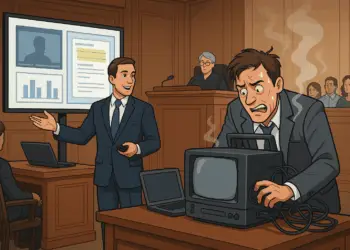
Civil attorneys increasingly rely on technology not just to present evidence, but to fill evidentiary gaps. Tools like:
- TrialDirector for visual storytelling
- TrialPad for visual storytelling
- PowerPoint or Prezi for sequencing timelines and gaps
- TrialLine – Interactive timeline software
- 3D reconstructions for accident or product liability simulations
- Medical illustrations to show injuries without radiology
are not just persuasive tools—they are necessary to meet jurors where they are.
Modern jurors expect a trial to function like a Netflix docuseries:
- A clear timeline
- Emotional beats
- A “moment” that clarifies liability or innocence
Attorneys can push back on this expectation—but they ignore it at their peril.
Investing in Trial Tech: How Top Legal Programs Are Leading the Way
Recognizing the shift in jury expectations and the growing need for visual storytelling in courtrooms, several premier legal organizations and institutions are training litigators to meet the moment. Programs like Temple University’s LL.M. in Trial Advocacy place trial technology front and center during their summer Bootcamp. Attorneys are immersed in real-world courtroom simulations, where they learn to use visual evidence tools such as TrialDirector, TrialPad, and other presentation software as part of their persuasive toolkit.
The legal profession isn’t waiting passively for change—it’s evolving through coordinated training and innovation. The Federation of Defense & Corporate Counsel (FDCC) has taken major steps in this direction through its Evolve program and Tech U, both designed to teach hands-on, high-stakes trial technology. These programs allow experienced litigators to engage directly with the tools and techniques that today’s jurors expect—from dynamic presentations to visual sequencing of testimony and evidence.
Similarly, the International Association of Defense Counsel (IADC) incorporates modern trial technology training into its trial academies and educational offerings. These sessions often include instruction on managing demonstrative evidence, syncing deposition video with transcript testimony, and mastering the visual narrative essential to courtroom persuasion in the digital era.
Collectively, these programs reflect a broader professional shift: trial advocacy now demands fluency in the visual language of persuasion. As digital expectations rise, forward-thinking lawyers are arming themselves with the skills—and the tech—to keep pace. Jurors are watching, expecting, and silently judging the story being told. And legal education is rising to meet that challenge.
Preparing the Jury for a Real-World Trial
One of the best ways to confront inflated expectations is to confront them head-on. Opening statements and voir dire offer opportunities to:
- Educate jurors on what evidence will and won’t be available
- Explain the real-world limitations of civil discovery
- Frame the absence of evidence as part of the story (not a hole in it)
For example:
“You might be wondering where the video footage is. This was a private home, not a retail store, and no Ring camera was installed. You’ll hear from the homeowner, and you’ll see photos taken afterward. That is the only evidence available—and it’s enough.”
This not only diffuses juror skepticism—it shows confidence in your case.
To understand why today’s jurors expect digital clarity, explore our deep dive into Generational Juror Communication.
Final Thoughts: A New Era of Expectation
The jury pool today lives in an information-saturated environment. Civil litigators must recognize that their audience arrives preloaded with expectations about what modern evidence “should” look like.
Your job isn’t just to meet those expectations. It’s to manage, shape, and where necessary, re-educate them. That means embracing trial technology, being transparent about limitations, and never assuming that jurors will give your evidence the benefit of the doubt just because it’s all you have.
In a world shaped by smartphones and streamable drama, the burden of persuasion is still legal—but the burden of presentation is now visual.
📘 Disclaimer
This blog post, “From News Anchors to Algorithms: How Civil Juries Changed with the Media Landscape,” is intended for informational and educational purposes only. It does not constitute legal advice or create an attorney-client relationship. While it discusses communication strategies and visual expectations in civil trials, readers should consult with a qualified attorney for guidance specific to their jurisdiction or case. The opinions expressed are those of the author and do not necessarily reflect the views of any affiliated organizations.