


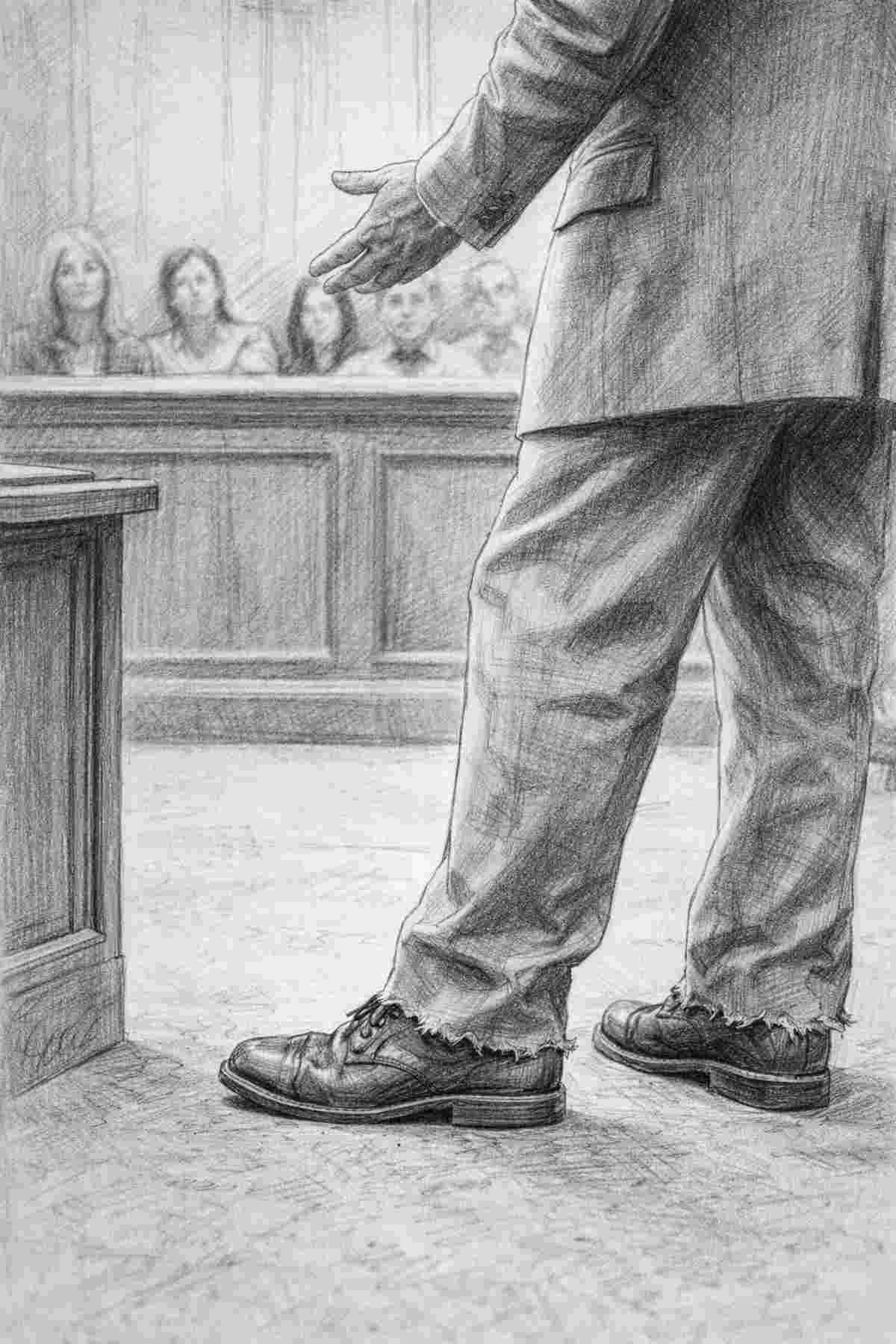
This courtroom story about what a transcript can—and cannot—capture comes from years inside a federal trial courtroom.
This courtroom story shows how trials often turn on human judgment, perception, and credibility—not only the evidence presented.
Told from the perspective of a court reporter in the U.S. District Court for the Eastern District of Pennsylvania, it captures how unrecorded moments, professional intuition, and courtroom culture can influence outcomes in ways no transcript ever reflects.
Answer Block
What can a courtroom transcript never fully capture?
A transcript preserves the words, but it can’t fully convey the tone, pauses, pacing, body language, or the emotional temperature of the room—details that often shape how testimony is received. That’s why trial teams need to prepare beyond the page: anticipate how moments will land, not just how they will read. The record is essential, but the real story of a courtroom moment often lives in everything happening between the lines.
🔑 Key Takeaways
- Federal trials are shaped by human judgment as much as evidence
- Courtroom credibility often turns on perception, restraint, and narrative framing
- Experienced advocates understand symbolism and timing
- Courtroom professionals operate within a culture of mutual respect
- The official record rarely captures the moments that matter most
The Setting
I was a court reporter in the United States District Court for the Eastern District of Pennsylvania when this case unfolded. To protect the identities of all involved, details have been intentionally generalized.
What follows is not about individual identities, but about the lived mechanics of the courtroom and how trials unfold in real time.
The case before the Court was a federal tax-evasion prosecution.
The defendant was no ordinary litigant. He was himself a highly respected criminal defense attorney in Philadelphia—well known, highly skilled, and deeply familiar with the system now judging him.
Daily Copy—and a Quiet Confidence
Before jury selection even began, the defendant—an attorney himself—asked to speak with me briefly. He requested daily copy, essentially same-day transcript production as the proceedings unfolded. He also made one point clear from the start: he did not want the transcript labeled for him or even primarily for his trial counsel, although they did get a copy.
To handle daily copy correctly, I needed the recipient information for packaging. I asked counsel for the name and other additional details so the transcript could be prepared and labeled properly for pickup. In our courthouse, law firms routinely sent runners to retrieve daily copy transcripts. They would come to the court reporters’ offices on the second floor, where the transcript packages were assembled and clearly labeled for the intended recipients. The runner would arrive, confirm the names, and take the packages.
What made this request unusual wasn’t daily copy itself—it was the destination. The defendant’s trial counsel would receive a copy in the ordinary course, but the defendant was far more concerned that each day’s transcript be packaged and labeled for an elder and respected veteran of the criminal defense bar—a lawyer he trusted, and the person at the center of the “story within a story” that follows. He needed the transcripts each evening.
Then came the detail that still makes me pause: he handed me a cash deposit on the spot. No check. No paper trail. Cash—on a tax case. He told me to keep track of the balance through the week and let him know what was due, and he would provide additional funds as needed.
Whatever the irony of that moment, the obligations stayed the same. I still had to produce the transcript promptly, provide the Court with the required copy, filed the original with the Clerk’s Office, and ensured that the government ultimately received the transcript copy it was entitled to at the same time.
And so each day, the record was made—then packaged, labeled, and picked up—with the as the intended recipient.
It was through that daily ritual, and that unusual delivery path, that another story surfaced.
He explained, quietly and without embellishment, why the older attorney needed the transcript each evening—and that explanation is what led to the story within the story.
A Story Within the Story: The RICO Trial
Years earlier, the older attorney had represented one defendant among six in a federal criminal RICO prosecution.
What Is Criminal RICO?
In the federal system, Criminal RICO (Racketeer Influenced and Corrupt Organizations Act) cases are designed to dismantle ongoing criminal enterprises. Prosecutors must prove not only individual crimes, but that defendants knowingly participated in a coordinated pattern of racketeering activity. These cases are evidence-heavy, witness-intensive, and often rely on testimony from FBI agents, undercover officers, and cooperating witnesses.
That trial lasted two weeks.
The government’s case was strong. The defense teams were seasoned and meticulous. When the evidence closed, the courtroom shifted into the familiar stillness that precedes closing arguments.
The Shoes
When it was the older attorney’s turn to speak, he began conventionally—walking the jury through the evidence.
Then he paused.
He asked the jurors to look at the attorneys representing the other defendants.
Handmade Italian shoes.
Silk ties.
Custom shirts.
Tailored suits.
Then he gestured to himself.
Throughout the trial, he had worn essentially the same suit each day.
No custom shirts.
No silk ties.
His pant cuffs were slightly frayed.
His shoes visibly scuffed.
Then he said:
“If my client were truly part of this enterprise—if he were making the kind of money the government suggests—wouldn’t you think he could afford a lawyer with better shoes?”
Was it theater?
Was it true?
Who can say.
What mattered was that the jury understood the point.
This is the kind of moment I discuss in Silent Advocacy—where presence, restraint, and perception can matter as much as words.
Back to the Present Trial
Returning to the tax-evasion case, something extraordinary happened mid-trial.
This happened just before the afternoon session began, while the jury was out at lunch and funneling back to the jury room. The judge called counsel—and the defendant himself—to sidebar and informed them that the defendant’s separate civil win against an Atlantic City casino, a $1 million verdict, had just been reversed by the appellate court.
That money had been intended to pay the taxes, penalties, and fines at issue in the criminal case.
In the 1980s, a million dollars was a staggering sum.
It vanished instantly.
It was, by any measure, a devastating moment.
Closing Arguments
The prosecution delivered a compelling closing argument.
When the prosecutor sat down, the defendant stood up.
Not his lawyer—the defendant himself.
For forty-five minutes, he addressed the jury directly. He spoke with ease, cadence, and instinct. He understood persuasion not as performance, but as a connection.
When the jury retired to deliberate, the anxiety was visible. Conviction now meant more than guilt—it meant financial and professional ruin.
The Verdict
Eventually, word came that the jury had reached a verdict.
The courtroom filled again. The judge reviewed the verdict sheet, paused, and had it returned to the foreperson.
Count by count, the verdict was announced:
Not guilty.
Not guilty.
Not guilty.
The relief on the defendant’s face was unmistakable.
The irony was impossible to ignore.
He had lost a million dollars.
But he had won his freedom.
What the Transcript Never Shows in a Courtroom Story
None of this appears in the official transcript.
Not the shoes.
Not the pauses.
Not the weight of consequence.
But these are the moments that explain how juries decide cases—and why courtroom experience can never be reduced to statutes, exhibits, or technology alone.
Some truths live only in the room.
❓ Frequently Asked Questions
Why don’t these moments appear in transcripts?
Transcripts capture words, not context—tone, appearance, pauses, and human reactions are not preserved.
What is daily copy in a federal trial?
Daily copy is overnight delivery of verbatim trial transcripts, often used in complex or high-stakes litigation.
Are courtroom stories like this common?
Yes. Many pivotal moments occur outside the formal record, understood only by those present.
Is this story based on real events?
Yes, though identifying details have been intentionally protected.
About the Author — Thomas G. Oakes
Thomas G. Oakes is a 45+ year legal professional in Philadelphia and the founder/editor of PhillyLegalNews.com and PhillyLegalConnect.com. He served for many years as an official court reporter in the Philadelphia Court of Common Pleas and the U.S. District Court for the Eastern District of Pennsylvania, and has worked as a freelance court reporter in state and federal courts for decades.
In addition to courtroom work, Tom is a nationally recognized leader in trial technology. He has trained lawyers, judges, and law students in TrialDirector and courtroom presentation, taught in Temple University’s LL.M. in Trial Advocacy technology curriculum (with special recognition), and has lectured nationally and internationally for organizations including the FDCC and IADC. He also founded the FDCC “FedTech U” program and has instructed in the FDCC Deposition Boot Camp.
Award: Temple University LL.M. in Trial Advocacy — 2013 Faculty Award for “Art of Technology in the Courtroom.”
Tom, prior to his retirement, was the principal of Thomas G. Oakes Associates, a Philadelphia-based litigation-support and trial-technology firm serving attorneys nationwide for more than 33 years.
Disclaimer
This article is for general informational and educational purposes only and does not constitute legal advice. Reading this content does not create an attorney–client relationship. If you need legal advice about a specific situation, consult a qualified attorney in the appropriate jurisdiction.