


Answer Block
What should a young trial lawyer focus on before handling their first real case?
Before the first case ever reaches a courtroom, the biggest advantage is mentorship—learning how experienced lawyers think, prepare, and protect the record. A good mentor teaches the “quiet work” that clients and juries never see: organizing facts, building a clean timeline, anticipating objections, and practicing clear, respectful communication. The result is confidence grounded in preparation—not performance—and a professional foundation that carries through every case that follows.
Key Takeaways
- Mentorship begins long before law school, often through exposure and observation.
- Presence matters more than formal instruction.
- Judgment, restraint, and reputation are learned — not lectured.
- Enduring relationships quietly shape professional credibility.
- The most important lessons never appear on a résumé.
How Mentorship in Law Shapes a Lawyer Before the First Case
It begins through exposure, observation, and trust — often years before law school — and is reinforced through presence, example, and enduring relationships that quietly form judgment, credibility, and restraint.
Long before my son ever stood up in a courtroom on his own, his education as a lawyer had already begun — not in a law school classroom, but through conversations, observation, and quiet guidance that exemplified mentorship in law from lawyers who understood that judgment matters more than flash.
This is the story of how mentorship shapes a lawyer before the first case is ever tried.
This philosophy of learning through example rather than display is part of what I’ve come to think of as Silent Advocacy — the quiet formation of credibility that happens long before a lawyer ever speaks in court.
The Decision After College
After graduating from Drexel University, my son, Thomas G. Oakes II, began seriously discussing law school. Those conversations took place the way many important family decisions do — around the house, over time, without urgency but with intent.
Tom had already been immersed in the trial world during his undergraduate years. He worked at my court reporting and trial technology company, assisted with courtroom presentation, and became a Certified TrialDirector Trainer while still in college. He wasn’t approaching law school as an abstraction. He had already seen how cases were built, presented, and preserved.
He took the LSAT and applied to all of the local law schools. He was accepted at Temple University Beasley School of Law, Villanova University Charles Widger School of Law, Rutgers Law School, and Drexel. Like many young graduates, he weighed familiarity against opportunity. At the time, he was leaning toward Temple, where he had helped teach some of the technology classes as an undergraduate.
A Quiet Question From George J. Lavin, Jr.
Around that time, I was speaking with George J. Lavin, Jr., someone I had known and worked with for years. In the course of our discussion, he asked me a simple question:
“Did Tom apply to Villanova Law?”
I told him yes — and that Tom had been accepted.
George paused and then asked another question that, in hindsight, said everything about how well he understood people as much as law:
“Has Betty ever been out to Villanova’s campus?”
Betty is my wife, and George knew her well. I told him she had not. George smiled and said, almost offhandedly:
“If Betty comes out to Villanova and sees the campus, she’ll want Tom to attend there.”
Lancaster Avenue
Villanova invited Tom to an open house for accepted students. That morning, we drove down Lancaster Avenue toward campus. As we came up over the hill, my wife looked out the window and said:
“What a beautiful building. Is that Villanova?”
I said yes.
She turned to Tom and said:
“You’re going here. I don’t have to worry about your safety.”
And just like that, the decision was made.
Before Law School Ever Entered the Conversation
Long before applications, résumés, or job titles, Tom had already been surrounded by the people and stories that quietly shape judgment.
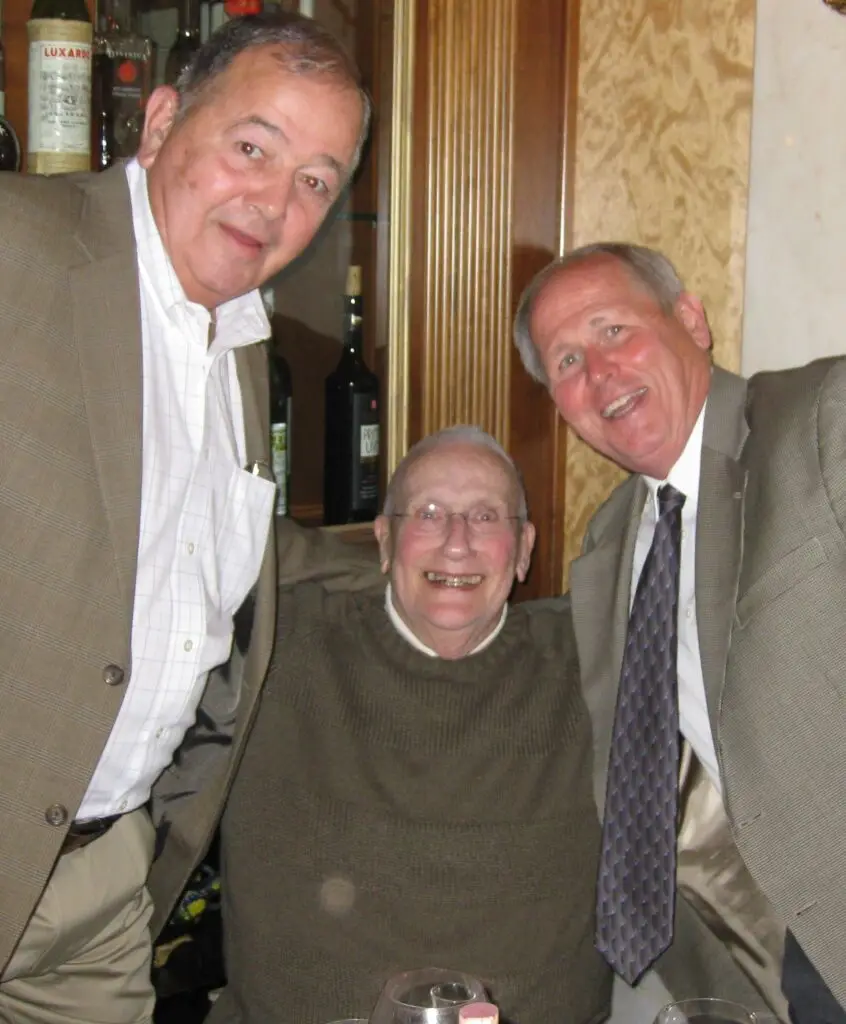
He had known Edward A. Gray and George Lavin since he was a kid — around twelve years old — not as mentors in any formal sense, but as men whose presence, friendships, and conversations formed a backdrop to growing up.
Some of the photographs that accompany this piece come from fishing trips to Canada taken many years ago — trips where fathers and sons shared time far from courtrooms and offices. Ed was there with his son Pat. George was there with his son, always called Maj, along with his daughter and later his grandson Kyle. Bill Ricci was there with his son Matt. Joe McGinley was there with his son Joe. I was there with my son Tom. Mike Poccabello joined us as well, along with his granddaughter.
In some of the photos, the boys are in a boat together. In others, they are boarding a small seaplane headed to a remote island to fish. At the time, no one was teaching law. But everyone was teaching something.
How adults talk to one another.
How friendships endure.
How reputation follows you long after the moment passes.
Those trips forged relationships that still exist today. And they taught lessons that don’t come from textbooks — lessons about trust, restraint, loyalty, and responsibility.
That kind of development starts early. And it matters later.

Presence Matters
When I told George Lavin that Tom had decided on Villanova, he said something I have never forgotten:
“If he goes to Villanova, I’ll be out there. Tom can come over any time to talk to me.”
George lived close to campus. And true to his word, he was there — available, present, quietly supportive.
Once Tom accepted Villanova’s offer, we found him an apartment close to campus. From there, the rest unfolded naturally. Being nearby mattered. It meant access — not just to classes, but to conversations, guidance, and the kind of informal mentorship that never appears on a syllabus.
Taking the Longer Road
While in law school, Tom had the opportunity to pursue a Master’s in Business Administration alongside his legal studies. It wasn’t the easier path. It meant a heavier workload and longer days. But George encouraged it.
Understanding the law, George believed, also meant understanding how a practice functions.
Tom completed his MBA shortly after passing the bar, adding a business foundation to his law degree from Villanova.
Learning Under Edward Gray
During law school, Tom also had the opportunity to serve as a summer intern with Edward A. Gray. After graduating, Tom sat for — and passed — both the Pennsylvania and New Jersey bar exams.
While waiting for the results, Tom was already working with Ed, who by then was at Eckert Seamans. Once the results came in, Tom continued working under Ed’s tutelage.
What followed was not simply employment. It was apprenticeship.
Even after Tom went on to his own practice, he and Ed spoke every week — about cases, decisions, strategy, and life. That kind of mentorship doesn’t end with a job title. It continues because both sides understand its value.
One of the clearest expressions of this idea came years later through a lesson learned from Ed Gray about reputation — a reminder that in this profession, credibility is built slowly and lost instantly.
The Foundations That Matter
From George Lavin and Ed Gray, Tom absorbed a standard that was never about trophies — it was about judgment, preparation, and trust.
Over time, that foundation showed up in the work, and the work has been recognized independently through honors such as Super Lawyers Rising Stars and other peer-recognized distinctions.
I mention that not as a measure of success, but as confirmation of something George and Ed understood early on — that credibility compounds quietly over time.
The Part That Never Shows on a Résumé
What Tom learned from George Lavin and Edward Gray cannot be reduced to bullet points.
It was learned through presence, example, restraint, and consistency.
When to speak.
When not to.
How to deal fairly with everyone in the legal arena.
Why reputation is the one thing you can never afford to lose.
Those lessons are rarely taught formally. But they shape careers.
And long before my son ever tried his first case alone, those lessons were already part of how he practiced law.
Frequently Asked Questions
Does mentorship really matter before a lawyer tries their first case?
Yes. The values, judgment, and habits that define a lawyer are often formed years before their first courtroom appearance.
Is mentorship only about legal skills?
No. The most important lessons involve judgment, restraint, ethics, and how to treat others — not just legal mechanics.
Can early life experiences influence professional credibility?
Absolutely. Exposure to trusted professionals and enduring relationships often shapes how lawyers carry themselves throughout their careers.
Why is presence so important in mentorship?
Because learning happens through observation and access — not formal instruction alone.
About the Author — Thomas G. Oakes
Thomas G. Oakes is a 45+ year legal professional in Philadelphia and the founder/editor of PhillyLegalNews.com and PhillyLegalConnect.com. He served for many years as an official court reporter in the Philadelphia Court of Common Pleas and the U.S. District Court for the Eastern District of Pennsylvania, and has worked as a freelance court reporter in state and federal courts for decades.
In addition to courtroom work, Tom is a nationally recognized leader in trial technology. He has trained lawyers, judges, and law students in TrialDirector and courtroom presentation, taught in Temple University’s LL.M. in Trial Advocacy technology curriculum (with special recognition), and has lectured nationally and internationally for organizations including the FDCC and IADC. He also founded the FDCC “FedTech U” program and has instructed in the FDCC Deposition Boot Camp.
Award: Temple University LL.M. in Trial Advocacy — 2013 Faculty Award for “Art of Technology in the Courtroom.”
Tom, prior to his retirement, was the principal of Thomas G. Oakes Associates, a Philadelphia-based litigation-support and trial-technology firm serving attorneys nationwide for more than 33 years.
Disclaimer
This article is for general informational and educational purposes only and does not constitute legal advice. Reading this content does not create an attorney–client relationship. If you need legal advice about a specific situation, consult a qualified attorney in the appropriate jurisdiction.