

Answer Block
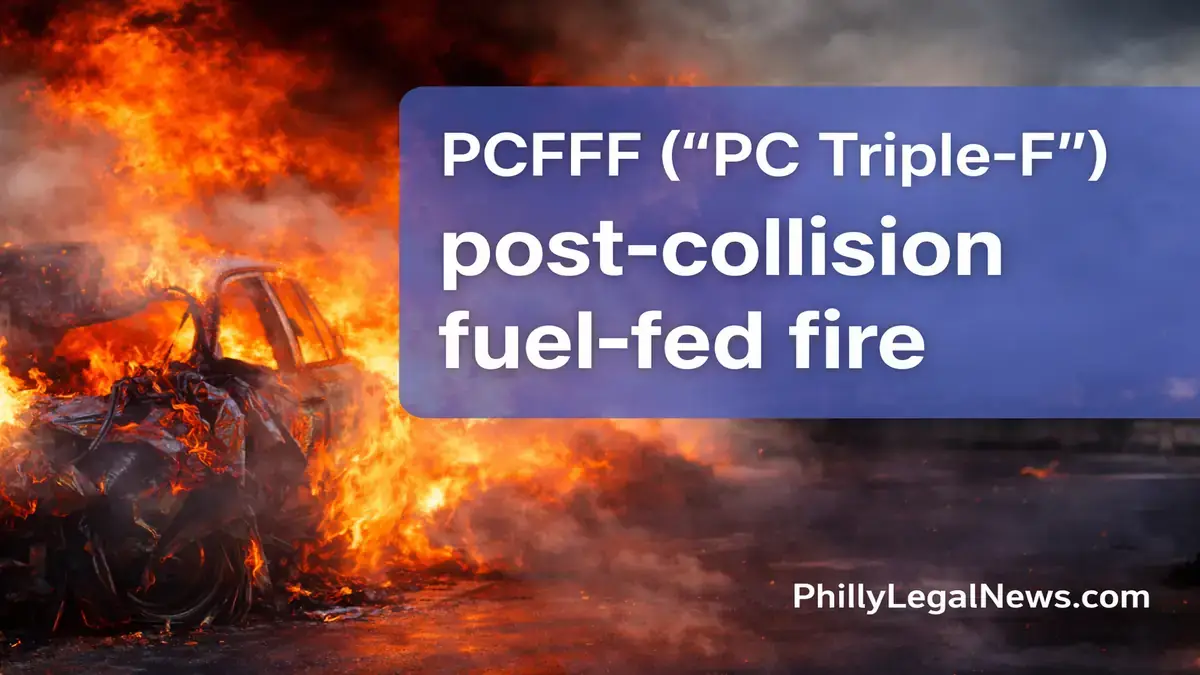
PCFFF — often spoken aloud as “PC Triple-F” — means post-collision fuel-fed fire: a rapid, high-intensity fire that can occur after a vehicle crash when the fuel system is compromised and fuel is ignited.
In the federal vehicle product cases I came up around in the late 1970s and early 1980s, the terminology wasn’t academic — it was the case. People built arguments from sequence, causation, design choices, and what the record actually said. I learned early that if you don’t understand the language, you can miss the meaning — and sometimes, you can miss the entire point.
Key Takeaways
- PCFFF (“PC Triple-F”) = post-collision fuel-fed fire: a post-crash fire that can start when fuel escapes a compromised fuel system and ignites.
- In serious products-liability matters—especially vehicle product cases—precision language matters. It isn’t “technical style.” It’s how experts and attorneys communicate cause, sequence, and responsibility.
- In high-stakes expert depositions, nothing is overlooked. Exhibit marking and cataloging, correct spellings of litigation-specific terms and jargon, and a clear set of stipulations are not small things—they help keep the record clean and usable when the case is moving toward trial.
- Trust in high-stakes matters is often earned quietly—through competence under pressure and fluency in the language.
- The attorneys and professionals you meet in this work can shape not only your career, but also the next generation—including, in my case, my son’s understanding of what law practice actually looks like.
PCFFF (“PC Triple-F”) in Plain English
You’ll see it written as PCFFF, and you’ll hear it spoken as “PC Triple-F.” Either way, it refers to a post-collision fuel-fed fire — a fire that occurs after a crash when:
- the vehicle’s fuel system is compromised (tank, lines, connections, components),
- fuel leaks or sprays into an unsafe environment, and
- an ignition source is present (heat, sparks, electrical activity, friction, or contact points created during the crash sequence).
The reason this term matters is that it’s often used by people trained to speak precisely: engineers, metallurgists, reconstructionists, fire investigators — and the lawyers examining them.
The Setting That Shaped My Ear for These Cases
Many people think product cases are about slogans or general opinions. In reality, the cases I was exposed to — often headed toward federal court — were about technical meaning, captured accurately, and used in motion practice and trial preparation.
I was fortunate to develop that ear for the language early, during my time in both the City and Federal courthouses in the late 1970s and early 1980s. And later, when I left to open my own court reporting and litigation support firm, that experience didn’t disappear. It became part of the value I brought: not theory, but familiarity with how these matters sound in real rooms with real experts.
The Call That Turned Experience Into Opportunity
Not long after opening my firm, I was fortunate to receive a call from Joseph V. Pinto, Esquire (White and Williams LLP) in Philadelphia. He was looking for someone experienced with the terms and language used in PCFFF (“PC Triple-F”) matters.
He also mentioned an associate — Tom Hinchey, Esquire — whom I knew from prior work in vehicle product liability cases. In this kind of litigation, trust builds fast when people recognize who has already been in the trenches — and who already speaks the language.
The deposition was of Campbell Laird (Metallurgist, University of Pennsylvania) — and like many expert depositions, it wasn’t only about what the expert knew. It was about whether the record would capture what the expert meant.
The Quiet Work That Happens Before the Record Starts
I arrived about a half hour early — my standard practice — so I could set up, confirm the caption, verify spellings, and review any witness lists or exhibit plans.
I also asked whether counsel wanted exhibits pre-marked, and what numbering system they preferred. In heavy technical cases, exhibit organization isn’t a convenience — it’s survival.
When you have numerous witnesses — and especially when multiple members of the same family share the same last name — you need a naming convention that stays clear months later, when someone is searching a transcript for a specific exhibit under pressure. That’s why I always thought about the record as a complete package: not just the Q&A, but also the exhibit index.
The exhibit index should appear at the front of the transcript, immediately after the appearance page, so anyone using the transcript can find an exhibit quickly and confirm exactly how it was marked.
Exhibit marking can be as simple as “D-1” (Defendant’s 1). But in matters with multiple depositions and a high exhibit volume, a witness-based convention often works better — for example: initials / last name / date. The goal is the same either way: keep the record unambiguous as the exhibit volume and deposition volume increases, and avoid duplication of exhibit identifiers across the full set of depositions in the case.
“Hello Tom. Another Scot.”
Before the deposition started and before Mr. Laird entered, defense counsel — Mr. Pinto and Mr. Hinchey — came in. I introduced myself, thanked Mr. Pinto for the opportunity. He told me he would need daily copy because trial was on the doorstep. I told him that would be fine.
I also asked about stipulations — especially read and sign timing — because everyone in the room knows the standard read-and-sign window does not always match a trial calendar. He thanked me for raising it and said he would address it with opposing counsel and the witness.
When plaintiff’s counsel entered with the witness, the witness turned to me and said, “Hello Tom. Another Scot.” He knew my last name was Oakes and thought I was Scottish. It was a small line — but I’ve always suspected it helped him remember me.
Then, before the deposition even truly began, he said something that told the room exactly why I was there:
“Hi, Tom. I am really happy to see you here for my deposition. I know you understand the language.”
At that point, the attorneys looked at me. I explained that I knew Mr. Laird from my time in the federal courthouse and from his testifying there.
Why That Moment Mattered
In technical vehicle product cases, everyone is listening for precision. The language is not ornament — it’s shorthand for:
- how a failure is described,
- how causation is sequenced,
- how design choices are evaluated, and
- how risk is framed.
When an expert says he is glad you are there because you “understand the language,” it signals something practical: that the record will be captured accurately and confidently — the way the expert intends — when it is later used in trial preparation and motion practice. This is the heart of what is called Silent Advocacy—especially in expert depositions, where precision and restraint do the heavy lifting.
A Second Track of Trust: The Lavin Firm and Vehicle Matters
Around the same time, I was also fortunate to be called to do reporting on General Motors cases through George J. Lavin, Jr., Esquire — a group known simply as “The Lavin Firm.” Although I knew Mr. Lavin from my time in the federal courthouse, he was then with Liebert, Short, Fitzpatrick and Lavin.
A key reason that opportunity opened up for me was William J. Ricci, Esquire. I met Bill in the federal courthouse during his first trial for his newest client, The Raymond Corporation. After I left the federal courthouse and started my firm, I reached out to Bill to see if I could be of service to him or his firm in any way. Bill took the time to speak to Mr. Lavin for me — and that conversation gave me my shot.
At first, I was called in sporadically. But over time, that work grew — and eventually my firm was handling as many as twenty depositions a week for The Lavin Firm. Through that work, I had the good fortune of working with outstanding trial lawyers, including Edward A. Gray, Esquire, Joseph E. O’Neil, Esquire, Thomas J. Finarelli, Esquire, and Francis P. Burns III, Esquire, among many others — on matters involving not only major auto manufacturers (including Toyota), but also forklift manufacturers and other product companies. The common thread was always the same: precision, preparation, and language that carried weight.
How the Logistics Were Handled
As the deposition proceeded, counsel and the witness agreed to the usual stipulations but reserved the right to read and sign — with the reading done on an expedited basis.
The practical plan was simple and disciplined:
- I would deliver the read-and-sign transcript package (including the errata sheet and signing documents) directly to Mr. Laird at the University of Pennsylvania.
- The original transcript, the original exhibits, and copies would be delivered to counsel.
That combination — technical fluency plus operational discipline — became one of the turning points of my career. It led to long-term trust and work that expanded beyond a single case or city.
A Personal Note: How This Work Shaped the Next Generation
I had been married about four years at the time, and we were expecting our first child — my son, who is now an attorney.
Over the years, watching how serious lawyers prepared, how they spoke to experts, and how they treated the record as something sacred had a real influence on him — not just learning the law, but learning how law is practiced: discipline, clarity, and respect for the details that decide outcomes.
If you’d like to learn more about my son’s product-liability practice, you can visit his page or read more here.
Practical Takeaway: If a Post-Crash Fire Is Suspected, Preserve Evidence Early
This article is about language and professional experience — not legal advice. But one practical point is universal:
If a post-collision fire is involved, evidence can disappear quickly. When issues of design, fuel-system integrity, and ignition sources are being evaluated, the ability to inspect and document matters early can be critical.
Ultra-Short Snippet FAQs
- What does PCFFF stand for? Post-collision fuel-fed fire.
- Why do people say “PC Triple-F”? It’s the spoken shorthand for PCFFF.
- Why does the term matter? Because experts and lawyers build arguments from precise sequences and technical meaning.
Editor’s Note: Additional Information
For readers who want a plain-English overview of product-liability issues in Philadelphia and South Jersey, our guide site PhillyLegalConnect has a practical primer here: The Philly Injury Playbook .
For more detailed information about serious motor-vehicle injury claims, you may also review:
Frequently Asked Questions
1) What is a post-collision fuel-fed fire (PCFFF)?
A post-collision fuel-fed fire is a fire that occurs after a crash when the fuel system is compromised, fuel escapes, and an ignition source causes the fuel to ignite. It is often spoken aloud as “PC Triple-F.”
2) Why are PCFFF matters considered product issues in some cases?
Because the analysis often focuses on whether the fuel system and related components were designed, placed, shielded, or protected in a way that reasonably accounted for collision forces — and whether an alternative design or warning could have reduced the risk.
3) Why do many serious vehicle product cases end up in federal court?
Often because the parties are from different states and the amount in controversy is significant, which can create federal jurisdiction in certain circumstances. Practically, many large manufacturers and multi-state litigation structures also contribute to federal-court filings.
4) Why is the language in these cases so particular?
Because experts may be explaining sequences, mechanisms, and technical causation. Small wording changes can alter meaning — and transcripts become documents used for motions, trial prep, and cross-examination.
5) What does “daily copy” mean, and why does it matter?
Daily copy is expedited delivery of a transcript, commonly requested when a case is close to trial. When trial is close, teams need testimony fast — and transcript accuracy becomes even more important.
6) Why include personal history and named attorneys in an authority article?
Because PLN is an authority site. Readers (and search engines) look for real-world signals: firsthand experience, credible settings, and consistent professional identity. The purpose is educational — to show how technical legal work is actually done and why precision matters.
About the Author — Thomas G. Oakes
Thomas G. Oakes is a 45+ year legal professional in Philadelphia and the founder/editor of PhillyLegalNews.com and PhillyLegalConnect.com. He served for many years as an official court reporter in the Philadelphia Court of Common Pleas and the U.S. District Court for the Eastern District of Pennsylvania, and has worked as a freelance court reporter in state and federal courts for decades.
In addition to courtroom work, Tom is a nationally recognized leader in trial technology. He has trained lawyers, judges, and law students in TrialDirector and courtroom presentation, taught in Temple University’s LL.M. in Trial Advocacy technology curriculum (with special recognition), and has lectured nationally and internationally for organizations including the FDCC and IADC. He also founded the FDCC “FedTech U” program and has instructed in the FDCC Deposition Boot Camp.
Award: Temple University LL.M. in Trial Advocacy — 2013 Faculty Award for “Art of Technology in the Courtroom.”
Tom, prior to his retirement, was the principal of Thomas G. Oakes Associates, a Philadelphia-based litigation-support and trial-technology firm serving attorneys nationwide for more than 33 years.
Disclaimer
This article is for general informational and educational purposes only and does not constitute legal advice. Reading this content does not create an attorney–client relationship. If you need legal advice about a specific situation, consult a qualified attorney in the appropriate jurisdiction.