


Introduction: When memory moved to the cloud
Back in July 2015, Kaspersky Lab published a study that grabbed headlines worldwide. The researchers coined the term digital amnesia to describe how people were forgetting information because they trusted their phones, laptops, and the internet to remember it for them. Over 90% of people surveyed admitted that they relied on their devices as an extension of memory, and nearly half said their phone contained “almost everything they wanted to recall”【Kaspersky, 2015†source】.
Ten years later, we aren’t just forgetting phone numbers. We’re outsourcing navigation, decision-making, schedules, even our conversations. What began as digital amnesia has transformed into digital dependence. This post explores what has changed, what the latest science says, and how we can use technology wisely without surrendering our most human faculties.
2015: The baseline for digital amnesia
The original Kaspersky report, The Rise and Impact of Digital Amnesia (2015), was based on surveys of thousands of participants across multiple countries【Kaspersky, 2015†source】. It found:
- 91% of people admitted they used the internet as a memory bank.
- 44% said their phone was their primary storage of important personal data.
- Even among adults, many couldn’t recall family phone numbers without checking a device.
Later the same year, Kaspersky published Digital Amnesia at Work, extending the concept into organizations: companies were offloading essential data to cloud services and shared drives, sometimes with little thought about backups or cybersecurity【Kaspersky, 2015 (workplace study)†source】.
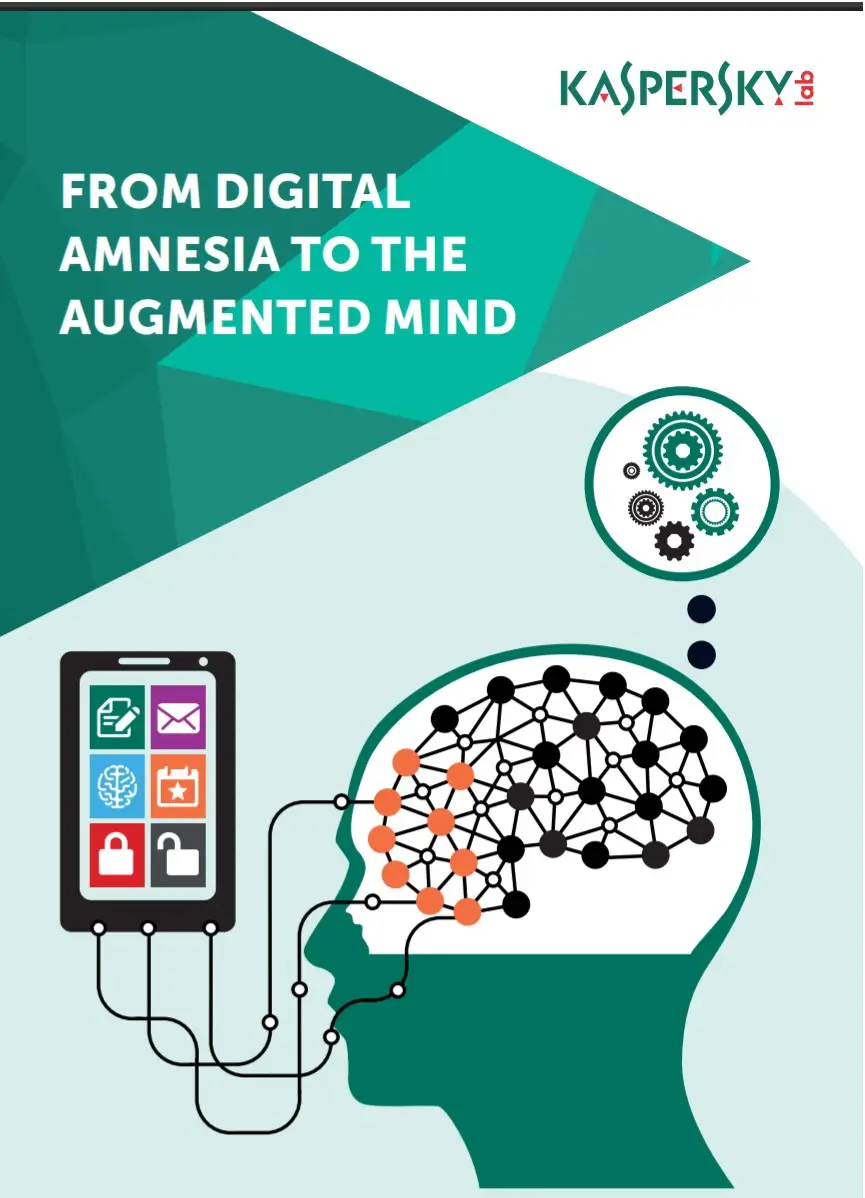
In 2016, they followed up with From Digital Amnesia to the Augmented Mind, arguing that outsourcing memory could be useful—but only if paired with strong digital hygiene and critical thinking【Kaspersky, 2016†source】.
Why this mattered: psychologists warned that memory works like a muscle—when we repeatedly look up facts instead of rehearsing them, long-term retention weakens. In other words: use it or lose it.
2025: What dependence looks like now
Fast-forward to today. Digital dependence is everywhere:
- Navigation: Many of us cannot comfortably get across town without GPS. Mental maps are fading.
- Scheduling: Reminders and notifications drive our daily routines.
- Identity: Password managers, autofill, and cloud vaults now hold keys to our financial and social lives.
- Decisions: AI assistants pre-sort information and suggest actions, often before we consciously choose.
1. Smartphone dependence
According to Pew Research Center, about 15% of U.S. adults are “smartphone-only” internet users, meaning they have no home broadband and rely exclusively on mobile devices【Pew Research Center, 2024†source】. Among lower-income households, the percentage is significantly higher.
2. Screen time
Global estimates suggest people now spend 6.5–7 hours/day on screens. In the U.S., adults average just over 7 hours【Backlinko, 2024†source】【Exploding Topics, 2025†source】. That’s nearly half of waking life mediated by a device.
3. Nomophobia
A 2025 systematic review covering 43 studies in 18 countries (36,656 participants) found that about 21% suffer severe nomophobia, 51% moderate, and 26% mild【Al-Mamun et al., 2025†source】. Anxiety without a phone is no longer a niche concern—it’s mainstream.
4. Youth and family life
Nearly 95% of U.S. teens have access to a smartphone, according to Pew【Pew Research Center, 2023†source】. Many teens report phones help with creativity and schoolwork, but others say phones hurt face-to-face social skills and create family conflict. Sweden’s health authority in 2024 went so far as to recommend no screens under age two and tight limits afterward, citing effects on sleep and mood【The Guardian, 2024†source】.
Cognitive offloading: science of forgetting by design
Cognitive offloading is the act of using external tools—lists, reminders, apps, AI—to reduce mental effort. It can be positive (pilots use checklists, surgeons use procedural notes). But when used unconsciously, it reshapes how memory works.
Recent studies highlight the risks:
- Shallower encoding: When people rely on devices, they process information less deeply, weakening recall【Musa et al., 2023†source】.
- Reduced rehearsal: Information rehearsed in mind strengthens retention; information “looked up” often doesn’t.
- Critical thinking displacement: Over-reliance on AI summaries reduces analytical effort and may pass along errors or biases【Zhai et al., 2024†source】.
A 2024–25 review on AI dialogue systems found that while helpful for productivity, unchecked use can weaken analytical decision-making—because users accept answers without cross-checking【Zhai et al., 2024†source】.
The psychology of dependence
Digital dependence is not just cognitive—it’s emotional and behavioral.
- Nomophobia prevalence: The 2025 meta-analysis showed severe phone anxiety affecting ~1 in 5 people【Al-Mamun et al., 2025†source】.
- Sleep disruption: A 2024 study of university students found 79% checked their phones at night, strongly linked to sleep disturbances【Guerra Ayala et al., 2024†source】.
- Self-esteem: Students with severe nomophobia were 11.7× more likely to have problematic phone dependency, tied to lower self-esteem and higher anxiety【Agüero-Espinoza et al., 2025†source】.
The psychological loop is partly neurological: constant notifications drive dopamine responses, reinforcing compulsive checking.
AI as the new amplifier
Unlike 2015, AI is now mainstream. Chatbots, copilots, and generative tools can draft emails, summarize articles, recommend legal strategies, and generate visuals. But this introduces new forms of dependence.
- Hallucinations and bias: AI can produce confident but false information; users who don’t verify may adopt errors【Zhai et al., 2024†source】.
- Skill atrophy: Repeated use of AI to generate structure or arguments may erode independent thinking【Gerlich, 2025†source】.
- Benefits when guided: Used well, AI reduces drudgery and can enhance learning (e.g., intelligent tutoring systems).
AI is not just storage—it’s interpretation. That makes dependence deeper than digital amnesia ever was.
Why this matters for professionals and courts
For lawyers, educators, and community leaders, these trends have direct consequences:
- Trials and jurors: Jurors raised on video clips and TikTok scrolls expect visual clarity. Pairing testimony with animations or demonstratives increases comprehension and retention.
- Continuity in emergencies: Clients may lose critical information if their device is lost. Encouraging non-digital backups matters.
- Ethics in AI: If AI generates a brief or argument, attorneys must verify sources. Courts increasingly demand transparency in AI use.
Practical playbook: balancing convenience and memory
- Active recall first: Before searching, pause and try to remember.
- Limit device dependency zones: Meals, bedtime, trials—set clear no-device norms.
- Backup critical info: Maintain wallet cards with key numbers and medications.
- AI as co-pilot, not pilot: Use it to outline and summarize, but keep judgment human.
- Teach by example: Model healthy device use for teens and peers.
FAQ
What is digital amnesia?
Forgetting information because you rely on a digital device to remember it【Kaspersky, 2015†source】.
How common is digital dependence?
In 2025, the average adult spends 6.5–7 hours daily on screens; 15% of U.S. adults are smartphone-only users【Pew, 2024†source】【Backlinko, 2024†source】.
What percentage of people suffer phone anxiety?
About 21% severe, 51% moderate, 26% mild nomophobia globally【Al-Mamun et al., 2025†source】.
Does AI make dependence worse?
Yes, if overused. Reviews show over-reliance can weaken critical thinking and lead to unverified errors【Zhai et al., 2024†source】.
Conclusion: Digital tools, human balance
The past decade transformed digital amnesia into digital dependence. Phones, apps, and AI are powerful allies—but without balance, they weaken memory, judgment, and connection.
The solution isn’t abandonment. It’s intention. Use the tool. Keep the mind.
Citations (clickable)
- Kaspersky Lab. The Rise and Impact of Digital Amnesia (2015). PDF
- Kaspersky Lab. Digital Amnesia at Work (2015). PDF
- Kaspersky Lab. From Digital Amnesia to the Augmented Mind (2016). PDF
- Pew Research Center. Americans’ Mobile Technology Use (2024). Link
- Pew Research Center. Teens, Social Media and Technology (2023). Link
- Backlinko. Screen Time Statistics (2024). Link
- Exploding Topics. Average Screen Time (2025). Link
- Al-Mamun F. et al. Prevalence of Nomophobia: A Systematic Review and Meta-Analysis (2025). PubMed
- Guerra Ayala MJ. et al. Nomophobia, phubbing, and deficient sleep in students (2024). Frontiers in Education
- Agüero-Espinoza FA. et al. Nomophobia and Self-esteem in Students (2025). Open Public Health Journal
- Musa N., Mukhtaruddin, Bakkara VF. Effects of Digital Amnesia on Knowledge Construction (2023). ResearchGate
Disclaimer:
This article is provided for informational and educational purposes only. It does not constitute legal, medical, or professional advice. Readers should consult qualified professionals regarding any specific questions about digital technology, health, or legal concerns.
Editor’s Note
This article is part of PhillyLegalNews’ Technology & Society series, where we explore the intersection of law, technology, and daily life. Written by Tom Oakes, a litigation technology educator with over 40 years of experience in courtrooms and legal seminars nationwide, this piece examines how digital amnesia has evolved into digital dependence and what it means for professionals, families, and our legal system in 2025.
For related articles, visit our Technology Updates section or explore our Silent Advocacy series.