In the courtroom, every detail matters. The words spoken, the images shown, and how those pieces come together shape the story that jurors, judges, and mediators take with them into deliberation. The ancient orators knew this truth well—and today, neuroscience and legal strategy affirm it: when you tell and show, your message sticks.
The Science of Memory Retention: What the Data Tells Us
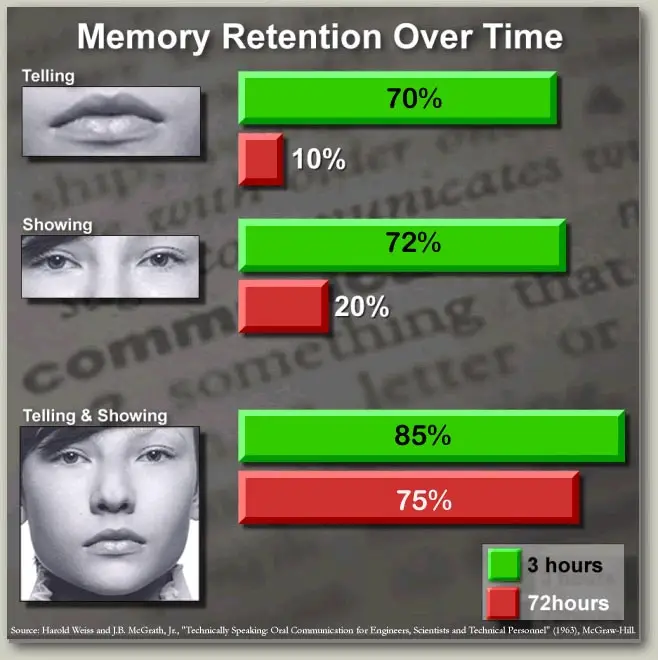
Look at the graphic above. It illustrates what we’ve long suspected but now can quantify:
- When a person is only told something, they retain 70% after 3 hours—but a mere 10% after 72 hours.
- If they’re only shown an image, retention is 72% after 3 hours and drops to 20% after 72 hours.
- But when someone is told and shown—that is, when you use words and visuals—retention stays remarkably high: 85% at 3 hours and 75% after 72 hours.
Memory retention drops drastically when people only hear or see information. Combining both leads to the highest long-term recall—critical for courtroom communication.
This isn’t just scientific trivia. This is trial strategy.
Seeing Reinforces Believing
Let’s take a basic example: you have three powerful exhibits—perhaps a key photograph, a critical diagram, and an email admission—placed on easels and positioned so the jury can see them throughout the trial. You’re not saying a word about them in that moment. But they’re seeing. And over the course of hours or days, that constant visual presence does something important: it reinforces your theme, quietly but powerfully.
This is connection. This is reinforcement. And it works.
As discussed in Temple Law’s Vision Science “101” for Trial Advocacy, understanding how jurors visually encode video evidence is critical. “The Video and Visuals in Court and on Appeal conference also reinforced best practices for ensuring admissibility and retention of trial videos.
Trial lawyers should not underestimate the silent force of visible exhibits. They influence memory, credibility, and judgment. Jurors are more likely to believe what they continuously see—especially if it aligns with what they hear.
The Classical Foundation: Cicero, Aristotle, and the Power of Persuasion
Marcus Tullius Cicero, Rome’s most famous orator, taught that persuasion relies on three pillars: logos (logic), pathos (emotion), and ethos (credibility). But Cicero also understood that the most effective rhetoric painted pictures in the minds of listeners. In De Oratore, he argued that vivid description could “bring things before the eyes”—even without literal images.
Aristotle emphasized metaphor and visualization. He believed rhetorical success came from helping the listener see what you meant. Renaissance theorists like Cesare Ripa, in his Iconologia, codified the symbols of human understanding. Visual iconography became a pathway to belief.
These thinkers understood what trial lawyers today must embrace: the brain believes what the eyes witness.
If a Picture Is Worth a Thousand Words…
We all know the phrase. But consider the scale:
- A photograph of a crash scene does more than any diagram can.
- A Ring camera capturing the fall in a premises liability case tells the story in seconds.
- A surveillance video showing who entered or exited a building becomes proof.
- A video deposition of a corporate rep revealing hesitation or evasion builds credibility.
- A social media clip of a product functioning perfectly, followed by a second clip of the failed version, creates the counter-point of a possible defect in real life circumstances.
So if a picture is worth a thousand words, what’s a video worth?
Perhaps a verdict.
Or a fair settlement.
Or your client’s best chance.
Crafting Clips That Stick
Let’s shift from theory to practice. A video clip is not just a convenience—it’s a strategic asset. It must be intentional:
- Repetition: Use key clips in both opening and closing, in examining witnesses; both with their testimony and others.
- Emotion: Capture tone, hesitation, or body language.
- Impeachment: Let the witness contradict themselves on video.
- Brevity: Focus on one idea per clip.
- Pacing: Insert clips to break monotony and restore focus.
Every litigator knows the power of a great quote. A video clip is a quote—but with tone, expression, timing, and credibility baked in. It sets the quote in motion.
Consider the jury at 4:00 p.m. on Day 4 of trial. Fatigued. Distracted. Overwhelmed. They won’t remember page 654 of Exhibit 41.
But they will remember the 12-second clip of a CEO saying, “I don’t recall reviewing that safety report.”
Judges, too, may not interrupt you to react—but they remember.
Mediators use well-timed clips to show opposing counsel risk. That 15-second highlight can do more than an hour of legal argument.
Video and visuals aren’t bells and whistles. They’re anchors.
Final Thoughts: Build to Be Remembered
If you’re not using photos and video to support your case, you’re relying on a strategy that science, experience, and ancient wisdom have already shown to be less effective.
So build for belief.
Use visual exhibits as anchors. Use clips as impact moments. Keep them visible. Keep them simple. Make them stick.
Because people believe what they see. And they remember what they hear and see.
PhillyLegalNews is your source for litigation strategy, trial technology, and courtroom persuasion.
🔗 Visit PhillyLegalConnect.com to discover how top trial lawyers prepare and win.
📬 Join our mailing list for weekly courtroom tips and tech updates.
Because your story deserves to be seen and believed.
Disclaimer:
The content provided in this article is for informational and educational purposes only and does not constitute legal advice. Viewing or interacting with this content does not create an attorney-client relationship. Legal strategies and outcomes can vary based on the specific facts of each case. For legal advice tailored to your situation, please consult a qualified attorney licensed in your jurisdiction.