

What Thomas v. Ford Motor Company Taught Me About Preparation, Tenacity and Trial Advocacy
Quick Answer: What Was Thomas v. Ford Motor Company?
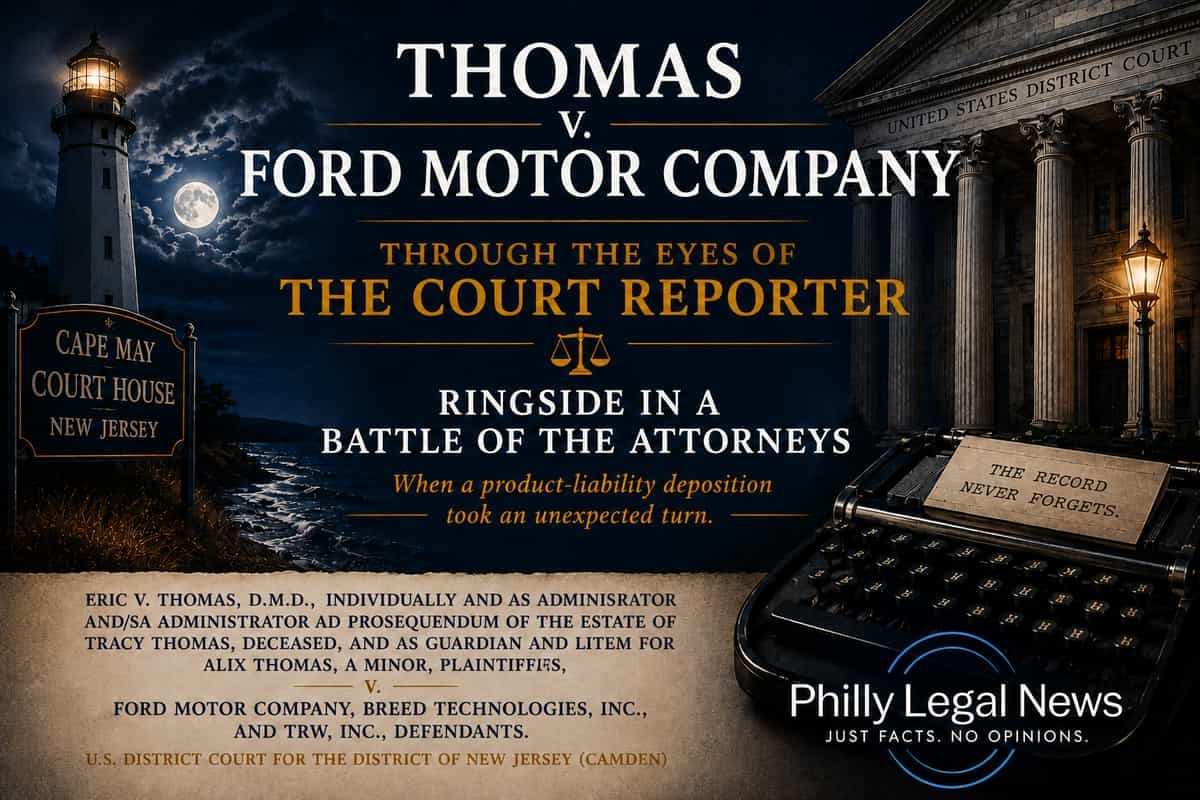
Thomas v. Ford Motor Company began as a products-liability and wrongful-death action involving allegations that an automobile airbag caused the death of Tracy Rose Thomas. The litigation also provides lasting lessons in expert consultation and trial advocacy. What makes the litigation worth revisiting today is not its notoriety. It is the work. Ford’s lawyers kept testing the allegations against the medical evidence, physical findings, witness testimony and engineering information. They worked with experts. They took depositions. They followed leads. When evidence did not fit the original theory, they continued investigating. I reported all of the Thomas v. Ford Motor Company depositions conducted throughout the State of New Jersey and watched that process develop firsthand. William J. “Bill” Conroy was relentless. Thomas M. “Tom” Hinchey was nonstop. Their work illustrates a fundamental lesson of trial advocacy: Preparation is not what happens before the advocacy. Preparation is part of the advocacy. That principle is also central to the Philadelphia Legal News series on Silent Advocacy. The underlying events occurred in February 1997 in Cape May Court House, New Jersey. Tracy Rose Thomas, who was pregnant, was found unresponsive in the driver’s seat of the family’s Ford Explorer after the vehicle struck a utility pole. Her husband, Dr. Eric Thomas, was in the passenger seat, and their young daughter was in the rear of the vehicle. The airbags had deployed. Tracy and her unborn child died. A products-liability and wrongful-death action followed against Ford Motor Company, TRW and Breed Technologies. Breed was later dismissed from the litigation.. The litigation initially centered on whether airbag deployment caused Tracy Thomas’s fatal injuries. As discovery progressed, Ford’s attorneys questioned whether the medical and physical findings supported that causation theory. That dispute ultimately expanded the scope of the litigation considerably. The competing theories were never resolved by a civil jury, and this article does not attempt to resolve them. The point here is how the lawyers worked through the evidence. Bill Conroy and Tom Hinchey represented Ford during the discovery I observed. Bill was relentless. Tom was nonstop. Tom handled many of the Rose family depositions in North Jersey and was deeply involved in the factual development and organization of the case. Bill pursued the medical and forensic evidence with extraordinary persistence. What impressed me was not any single question. It was the work behind the questions. Documents had to be reviewed. Witnesses had to be examined. Medical findings had to be understood. Engineering issues had to be translated into terms lawyers and witnesses could work with. Chronologies had to be built. Experts had to be consulted. And when an answer raised another issue, someone had to follow it. That is what good trial lawyers do. They do not stop because the case has become more complicated. They do the additional work. Products-liability lawyers cannot be engineers, physicians and forensic pathologists at the same time. They do not have to be. They do have to know how to work with people who possess that expertise. Ford’s defense included engineers, consulting experts and medical and forensic specialists. One of those experts was Dr. Michael Baden, the well-known forensic pathologist. Lawrence Schiller’s account describes Conroy developing portions of his examination of Dr. Elliot Gross after consultation with Baden. That is an important example of how expert preparation works. The expert supplies specialized knowledge. The lawyer has to understand it. Then the lawyer has to turn it into useful questions. The witness answers. The answer is compared against the rest of the evidence. And the investigation continues. Later, Glenn A. Zeitz became involved in Ford’s defense and brought substantial criminal-law experience to a case that had developed issues well beyond a conventional products-liability dispute.
Ford was not the only defendant developing the record.
Anne Marie “Ann” Walsh, then with Lord, Bissell & Brook in Chicago and now counsel at Troutman Pepper Locke, represented TRW and participated in important expert discovery.
Robert J. “Bob” Hafner, then with Lavin, Coleman, O’Neil, Ricci, Finarelli & Gray and now a partner at Goldberg Segalla, also represented TRW during portions of the litigation.
Ann was present during the deposition of Dr. Gross.
My recollection is that she continued questioning Dr. Gross after Bill stopped his examination that day.
That is worth noting because complex discovery is rarely the work of one attorney pursuing one line of inquiry.
Different lawyers represent different interests.
They listen differently.
They test different parts of the same evidence.
That is one reason the phrase Battle of the Attorneys is so useful. The contest often begins in discovery, long before the jury ever sees the case.
One deposition remains especially useful as an example of preparation in action. Dr. Elliot Gross was examined concerning the medical findings surrounding Tracy Thomas’s death. The questioning included petechial hemorrhaging and findings involving the neck and hyoid region. Petechial hemorrhages can be significant in evaluating possible asphyxial processes, but they do not by themselves establish a particular mechanism of death. Conroy worked through those issues methodically. What did the findings mean? Could the brief event associated with airbag deployment account for them? What did the hyoid-area findings show? What did the surrounding tissue show? Could pressure applied to the neck account for the findings? The questions followed one another because the foundation had been laid.
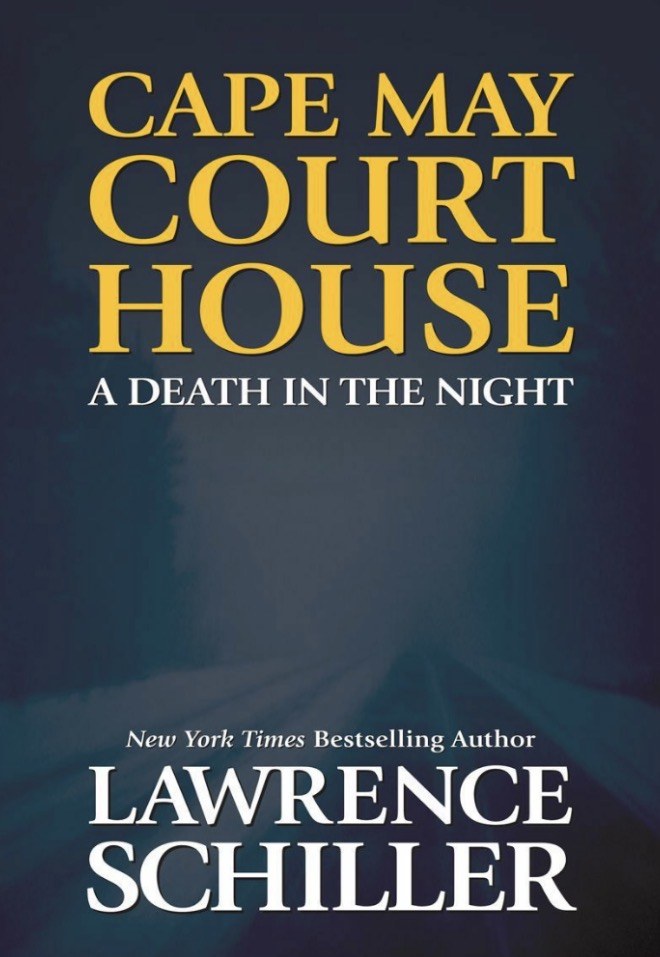
Lawrence Schiller’s Cape May Court House: A Death in the Night chronicled the Thomas litigation and the extraordinary issues that developed during the case.
Schiller’s book provides an important historical account of the litigation.
He did not interview me.
He did have access to deposition material, including the exchange involving the Gross examination.
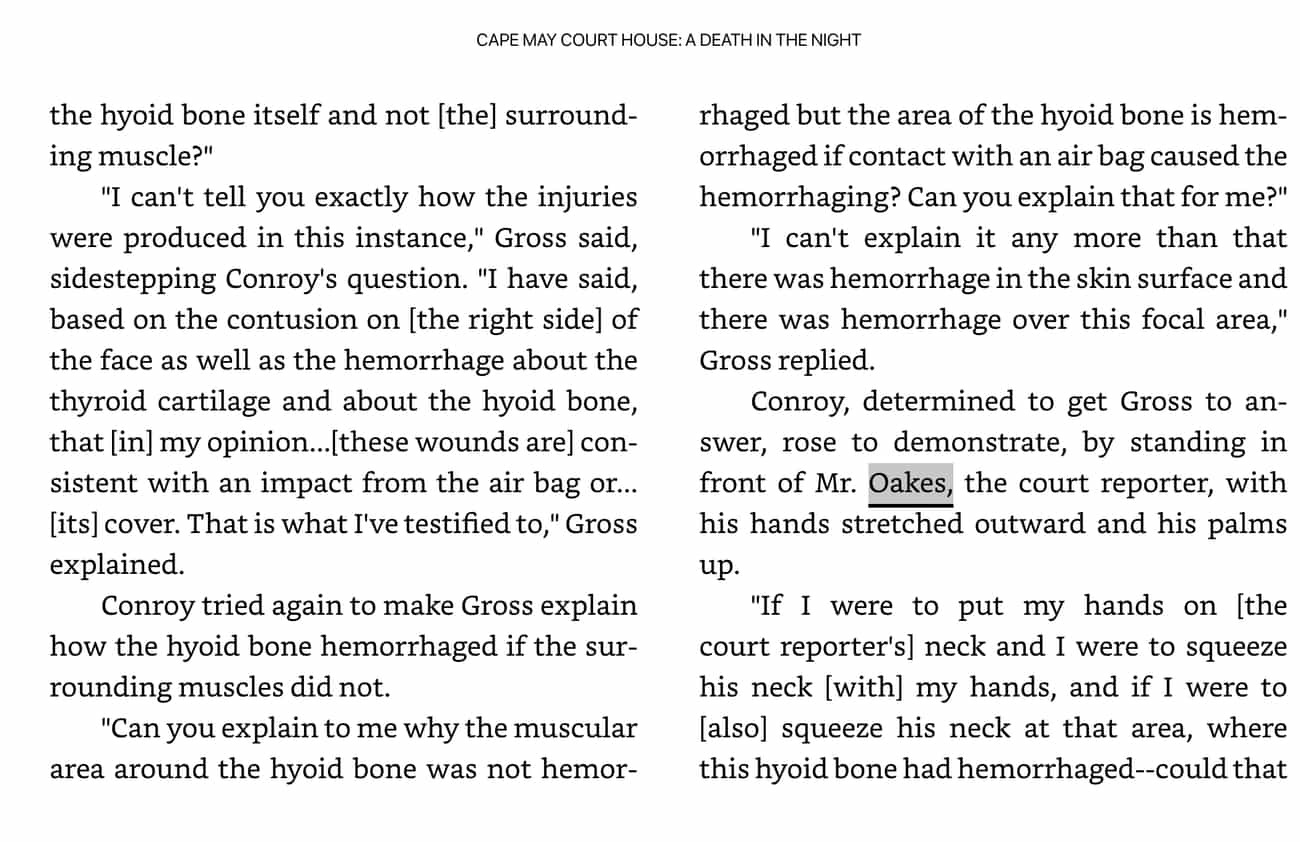
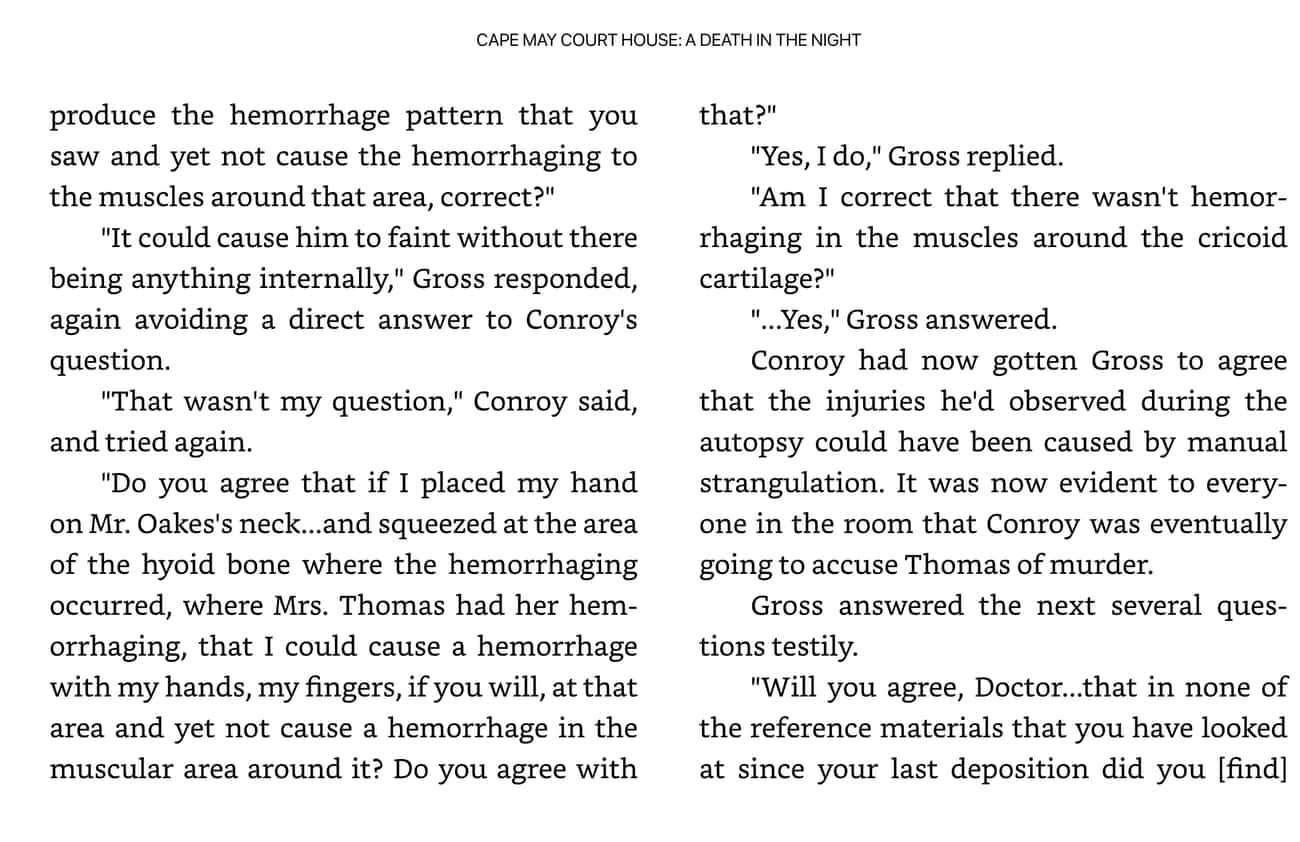
For this article, the book serves two useful purposes. It provides an outside published account of the litigation. And it preserves portions of the deposition record that readers can compare with the firsthand recollection presented here. That is why I believe the limited excerpt showing the Conroy-Gross exchange belongs in the article. Lawrence Schiller later chronicled the case in Cape May Court House: A Death in the Night. His account of the Gross deposition identifies: “Mr. Oakes, the court reporter.” The deposition exchange he reproduces also contains Conroy’s reference to: “Mr. Oakes’s neck.” Selected excerpt from Lawrence Schiller’s Cape May Court House: A Death in the Night, recounting part of William J. Conroy’s examination of Dr. Elliot Gross. Schiller identifies “Mr. Oakes, the court reporter,” and the deposition exchange contains Conroy’s reference to “Mr. Oakes’s neck.” I was seated at the head of the table. Bill was seated next to me. As he continued the hypothetical reflected in the transcript, he stood, moved behind my chair and placed his hands around my neck to demonstrate the physical mechanism he was asking Dr. Gross to consider. I continued reporting. The demonstration is memorable because it was unusual. But professionally, the more important point is why Bill was able to make it. He knew the medical evidence. He understood the timing issue. He had consulted forensic expertise. He had developed the foundation. He knew what he wanted the witness to address. The demonstration was not a substitute for preparation. It was the product of preparation. That is the lesson. The Gross deposition did not end the inquiry. Ford’s attorneys continued taking testimony and following information developed through discovery. Members of Tracy Rose Thomas’s family had concerns about the circumstances surrounding her death. I reported a number of those family depositions in North Jersey. The lawyers also pursued other factual information that developed during the litigation. As the issues expanded, portions of discovery eventually took place under close judicial supervision in the United States District Court in Camden. U.S. Magistrate Judge Joel B. Rosen played an important role in managing that discovery. The significant point is not that the case produced one dramatic revelation. It did not work that way. The record was built piece by piece. A witness. A document. An expert. Another deposition. Another question. That is how substantial litigation is developed. Great lawyering also requires a client willing to support the work. A sophisticated corporate client must give counsel access to the people who understand the product. It must make engineering and technical information available. It must authorize appropriate expert consultation. It must listen when counsel explains that additional investigation is required. And it must trust the judgment of the lawyers it has chosen. But that trust must be earned. Trial counsel has corresponding responsibilities. Keep the client informed. Understand the evidence. Explain developments clearly. Identify the need for another expert or another deposition. Acknowledge when something does not fit. Recommend what should happen next. And then do the work. In significant litigation, a client is entrusting counsel with more than a file. The lawyers may also be carrying part of the client’s reputation on their shoulders. From what I observed, Ford gave its defense team the resources and latitude necessary to investigate the case thoroughly. Conroy, Hinchey and the people working with them used that opportunity. They followed the evidence. That is what a good client should enable — and what good lawyers should deliver. The Thomas litigation fits naturally with the principles discussed in Philadelphia Legal News’ Silent Advocacy series. Preparation is advocacy. Knowing the record is advocacy. Listening is advocacy. Working effectively with experts is advocacy. Communicating with the client is advocacy. Knowing when an answer requires another question is advocacy. And doing the work nobody outside the litigation may ever see is advocacy. That is also what George J. Lavin Jr. and Chilton Davis Varner described as the Battle of the Attorneys. The battle does not begin with opening statements. It begins much earlier. Deposition practice has changed enormously since the Thomas litigation. Lawyers now have realtime transcripts, synchronized video, digital exhibits, searchable databases, interactive timelines and artificial intelligence. Those tools are valuable. They can make the work faster. They can make evidence easier to organize and present. They cannot replace preparation. They cannot replace careful listening. They cannot replace understanding the evidence. And they cannot replace judgment. The technology changes. The work does not. After many years around trial lawyers, I have learned that the most important work is often the least visible. A good examination does not begin when the lawyer asks the first question. It begins with the preparation that came before it. The documents. The experts. The chronology. The client conversations. The prior testimony. The questions that did not work. The leads that had to be followed. And the willingness to keep going. That is what I remember about Bill Conroy and Tom Hinchey. Bill was relentless. Tom was nonstop. The lesson of Thomas v. Ford Motor Company is not that litigation produces dramatic moments. The lesson is that great lawyers do the work necessary to be ready when the important moment arrives.
Beginning in the early 1980s, I served as the court reporter for all of the Thomas v. Ford Motor Company depositions conducted throughout the State of New Jersey.
During those years, I was fortunate to develop a close professional working relationship with Ford Motor Company and with a number of the attorneys who represented it in significant litigation.
That experience gave me an opportunity to observe, at very close range, how sophisticated products-liability cases were investigated, prepared and defended.
This article reflects that professional perspective.
I served as court reporter for Ford-noticed depositions in Thomas v. Ford Motor Company. Lawrence Schiller later discussed the litigation in Cape May Court House: A Death in the Night and identifies “Mr. Oakes, the court reporter” during his account of the Dr. Elliot Gross deposition.
The article is not intended to retry the case or resolve the disputed circumstances surrounding Tracy Thomas’s death.
Its purpose is to examine something different: preparation, investigation, expert consultation, the lawyer-client relationship and the discipline required to follow evidence wherever it leads.
— Thomas G. Oakes Silent Advocacy: The Hidden Force Behind Trial Success Silent Advocacy: Winning the “Battle of the Attorneys” Interactive Depositions in Philadelphia Trial & Deposition Technologies How Technology Changed Depositions: What Lawyers Must Know William J. Conroy — Campbell Conroy & O’Neil Thomas M. Hinchey — Campbell Conroy & O’Neil
Thomas v. Ford Motor Company — Glenn A. Zeitz
Thomas v. Ford Motor Co., 111 F. Supp. 2d 529 (D.N.J. 2000) It was a products-liability and wrongful-death action arising from the death of Tracy Rose Thomas following a Ford Explorer collision in Cape May Court House, New Jersey. The litigation initially centered on allegations involving airbag deployment. The examination addressed medical findings including petechial hemorrhaging and findings involving the neck and hyoid region. It provides a useful example of how expert consultation, preparation and careful questioning can affect the direction of discovery. According to Thomas G. Oakes’s firsthand recollection, Conroy rose from the chair beside him, moved behind him and placed his hands around Oakes’s neck while continuing a hypothetical examination concerning neck compression. Yes. Schiller identifies “Mr. Oakes, the court reporter” while recounting the Gross deposition. The deposition exchange reproduced in the book also contains Conroy’s reference to “Mr. Oakes’s neck.” No. The article does not attempt to determine criminal responsibility or resolve the competing causation theories. Its focus is the litigation process and the professional lessons arising from it. The case demonstrates that advocacy begins long before trial. Preparation, organization, expert consultation, client communication, command of evidence and persistence all shape the effectiveness of trial counsel.Key Takeaways From Thomas v. Ford Motor Company
The Thomas v. Ford Motor Company Case
Bill Conroy and Tom Hinchey: Following the Evidence
Great Lawyers Know When They Need Experts
The Other Lawyers in the Room
The Deposition of Dr. Elliot Gross
Lawrence Schiller and Cape May Court House: A Death in the Night
The Demonstration Recorded in Schiller’s Book
The Investigation Continued
What a Great Client Gives Its Lawyers
Silent Advocacy and the Battle of the Attorneys
Technology Changes. The Work Does Not.
The Lesson From the Court Reporter’s Chair
Editor’s Note
Editor, Philadelphia Legal News
Related Reading
Preparation, credibility, organization and courtroom presence as forms of advocacy.
How preparation and credibility shape the contest between lawyers long before closing argument.Campbell, Conroy & O’Neil
Current professional biography.
Current professional biography.Case Materials and Sources
Historical materials and commentary concerning Ford’s defense.
Published federal court decision concerning the litigation.
Frequently Asked Questions
What was Thomas v. Ford Motor Company?
Why is the Dr. Elliot Gross deposition important?
What happened during Bill Conroy’s demonstration?
Does Lawrence Schiller identify Thomas G. Oakes in the book?
Does this article determine what caused Tracy Thomas’s death?
What is the connection to Silent Advocacy?
About the Author — Thomas G. Oakes
Thomas G. Oakes is a 45+ year legal professional in Philadelphia and the founder/editor of PhillyLegalNews.com and PhillyLegalConnect.com. He served for many years as an official court reporter in the Philadelphia Court of Common Pleas and the U.S. District Court for the Eastern District of Pennsylvania, and has worked as a freelance court reporter in state and federal courts for decades.
In addition to courtroom work, Tom is a nationally recognized leader in trial technology. He has trained lawyers, judges, and law students in TrialDirector and courtroom presentation, taught in Temple University’s LL.M. in Trial Advocacy technology curriculum (with special recognition), and has lectured nationally and internationally for organizations including the FDCC and IADC. He also founded the FDCC “FedTech U” program and has instructed in the FDCC Deposition Boot Camp.
Award: Temple University LL.M. in Trial Advocacy — 2013 Faculty Award for “Art of Technology in the Courtroom.”
Tom, prior to his retirement, was the principal of Thomas G. Oakes Associates, a Philadelphia-based litigation-support and trial-technology firm serving attorneys nationwide for more than 33 years.
Disclaimer
This article is for general informational and educational purposes only and does not constitute legal advice. Reading this content does not create an attorney–client relationship. If you need legal advice about a specific situation, consult a qualified attorney in the appropriate jurisdiction.