

Intro:
In a world where information once arrived from trusted, centralized sources, today’s communication channels are fragmented, fast, and deeply visual. Trial lawyers are no longer addressing a jury raised on Walter Cronkite and newspapers — they’re speaking to a generation raised on smartphones, social media, and scrolling. Understanding generational juror communication is no longer optional — it’s essential.
Let’s examine how communication has changed and what that means in the courtroom, where clarity, credibility, and persuasion matter most.
📰 A Simpler Time: Trusted Sources and Unified Narratives
There was a time when the public consumed news from just a handful of sources:
- The nightly television broadcast
- Morning and evening newspapers
- Weekly or monthly magazines
People trusted voices like Walter Cronkite, often called “the most trusted man in America.” When he signed off with “And that’s the way it is,” it was more than a phrase — it was a signal that the story was settled. The flow of information was linear, reliable, and slow by today’s standards.
📱 The Digital Shift: Instant Information and Endless Inputs
Fast forward to today: We live on an information highway that’s always on. X, Facebook, Instagram,, LinkedIn — each platform offers real-time updates, but also chaos. Facts compete with opinions. Headlines are optimized for clicks. Visuals dominate over words.
As John Mayer sings in “Waiting on the World to Change”:
“When you trust your television, what you get is what you got,
‘Cause when they own the information, ooohhh, they can bend it all they want!”
Today, information isn’t owned — it’s amplified, shared, and refracted through digital networks. And your jury? They’ve been shaped by this digital immersion.
🧠 Digital Amnesia Is Real
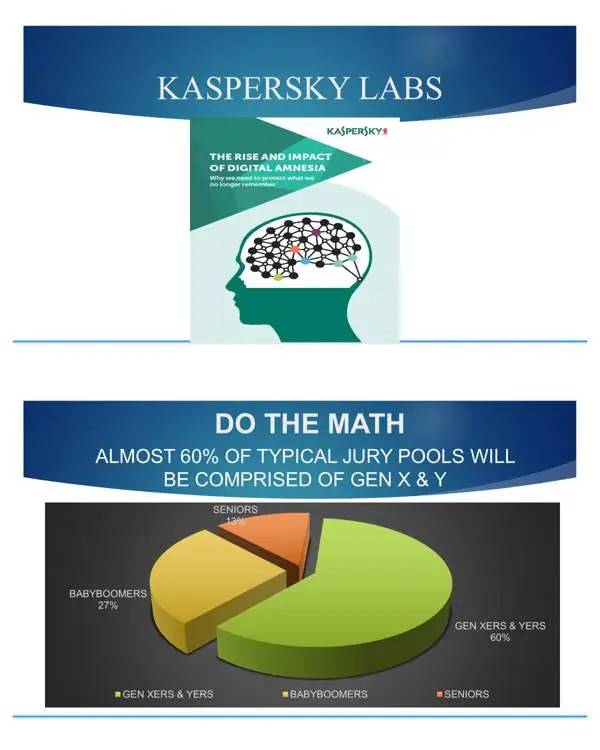
According to a Kaspersky Lab study, modern smartphone use is impacting how we store and retrieve information. Their findings:
- 91% of people surveyed said they use the internet as an extension of their memory.
- Nearly half rely on their phones to remember everything — including phone numbers, appointments, and facts.
This condition is known as digital amnesia. Rather than retain information, we rely on constant access. Jurors today may not recall your strongest fact — unless you present it memorably.
🧬 The Science of Attention and Memory in Modern Jurors
Modern jurors, particularly those from Gen X and Millennials, are not only tech-savvy — they are cognitively conditioned by constant digital input. Researchers have coined terms like “cognitive offloading” and “continuous partial attention” to describe how people process information in the digital age.
- Cognitive offloading refers to the habit of using devices like smartphones to remember tasks, dates, facts — even directions. The brain adapts by offloading memory storage onto tech, weakening internal recall.
- Continuous partial attention means that people rarely give full, sustained attention to one thing. Instead, their focus shifts rapidly between tasks, notifications, and stimuli.
For lawyers, this means your audience may:
- Miss nuanced arguments
- Tune out mid-sentence
- Need frequent reengagement cues to maintain focus
📸 Alone Together: The Visual Disconnect
In courtrooms and conference rooms alike, we’re often physically present but mentally elsewhere. A visual from the presentation says it best — “People gathered together… all alone.” Heads down, screens up.
As litigators, you’re not just fighting the opposing side. You’re fighting for attention. And attention, especially among digital natives, is earned with clarity and visuals.
⚖️ Today’s Jury Pool: A Generational Breakdown
Understanding who’s in the box is the first step toward persuasion.
| Generation | Birth Years | Characteristics |
|---|---|---|
| Baby Boomers | 1946–1964 | Grew up on TV, respect hierarchy |
| Gen X | 1965–1980 | Skeptical, tech-adapted |
| Gen Y (Millennials) | 1981–1996 | Digital-first, visual learners |
| Gen Z (Emerging) | 1997–2012 | Screen-native |
Based on courtroom trends, over 60% of today’s jury pools are now composed of Gen X and Gen Y — people raised with personal computers, cable TV, and eventually smartphones. Their expectations are different from the jurors of the past.
⚖️ The Impact of Media Evolution on Juror Expectations
Baby Boomers expected formality and deference from professionals. Gen X expected evidence and skepticism. Millennials and Gen Z, however, expect transparency, narrative, and visual substance.
Media evolution has created a generation of jurors who:
- Watch true crime documentaries
- Follow legal commentary on YouTube
- Consume stories through TikTok trial recaps
They’re not passive recipients. They’re savvy, curious, and often judgmental about:
- Body language
- Presentation style
- Whether your tone seems authentic
📺 They expect your presentation to feel modern. Foam boards, diagrams, and demonstratives aren’t extras — they’re minimum requirements for engagement.
💡 Trial Tip: Think of yourself as both advocate and storyteller. Your visuals should guide your story, not just support it.
🧬 What Works: Blending Oral + Visual
The Weiss-McGrath study on retention showed the following after 72 hours:
- 10% retention from oral presentation alone
- 20% from visuals alone
- 65% retention when both were combined
This is not theory. It’s psychology. Jurors remember what they see and hear together.
“I hear and I forget. I see and I remember.” Confucius
“For hands-on strategies on using visual tools in court, read Blending Trial Technologies.”
🔄 Blending Traditional Values with Modern Tools
There’s no need to abandon traditional courtroom decorum. In fact, it’s the blend of classic ethos with modern delivery that makes an attorney persuasive across generations.
🔹 Use the credibility associated with older practices (clear diction, courtroom etiquette).
🔹 Pair it with modern enhancements (key visuals, succinct summaries, real-time annotation).
This approach ensures:
- Baby Boomers feel respected.
- Gen X sees logic and structure.
- Millennials and Gen Z get engaged through format and flow.
📣 And it positions you as adaptable, which enhances juror trust — regardless of age.
🔑 Trial Strategy Tip:
If your closing argument doesn’t include:
- Compelling visuals
- Simplified takeaways
- Repetition of your strongest point
…you’re likely falling behind the jury’s attention span.
🎯 Practical Tips for Communicating Across Generations
Here’s how to reach today’s mixed-generation juries:
👁️ 1. Visualize Everything
- Use trial graphics, foam boards, animations.
- Keep images clean, high-contrast, and relevant.
🔄 2. Repeat and Reframe
- Repetition isn’t redundant — it’s reinforcement.
- Frame the same point in different formats.
📱 3. Speak in Visual Soundbites
- Think like a 30-second Instagram Reel: “She had the light. He hit her. That’s negligence.”
💡 4. Avoid Legalese
- Use plain language.
- Define terms once, then repeat them clearly.
⚖️ 5. Respect All Generations
- Boomers may want formality and clarity.
- Gen X wants logic.
- Millennials value authenticity and transparency.
📌 Conclusion: The Courtroom Isn’t Immune to Change
Jurors may not be on their phones during trial, but they’ve been shaped by their phones long before they entered the courtroom. As a trial lawyer, your job is not just to tell a story — it’s to translate it into a format your jury retains.
Generational juror communication is a skill. And like all good advocacy, it takes awareness, preparation, and empathy.
📘 Disclaimer
The content provided in this blog post, “From a Simpler Time to the Digital Now: Juror Communication Strategies That Work,” is for informational and educational purposes only. It does not constitute legal advice, nor does it establish an attorney-client relationship. Readers are encouraged to consult with a qualified legal professional for advice tailored to their specific circumstances. The views expressed are those of the author and do not necessarily reflect the views of any organization or institution referenced.