


By Thomas G. Oakes
Court Reporter • Litigation Technology Professional • Certified TrialDirector Trainer • Former Instructor, Temple University LL.M. Trial Advocacy Program
Answer Block
How can realtime court reporting improve the accuracy of an international expert deposition?
Some of the greatest lessons in litigation technology have very little to do with technology itself. They begin with the way experienced trial lawyers think.
More than 30 odd years ago, I participated in an international products liability deposition involving a Japanese automotive engineer (corporate designee), two interpreters, and one of the finest trial lawyers I ever had the privilege of working alongside — Edward A. Gray, Esquire. What appeared to be a routine deposition became a remarkable lesson in preparation, early realtime court reporting, litigation technology, and protecting the integrity of the record. By combining early realtime court reporting with thoughtful preparation and multiple language safeguards, Ed created a process that allowed potential translation issues to be identified and resolved before they became part of the official record. The experience demonstrated that technology is most valuable when it supports careful preparation.
For additional examples of how litigation technology has evolved over the past four decades, visit our Trial & Deposition Technologies hub.
Key Takeaways
- Preparation begins long before testimony. Exceptional litigators prepare the process-not just the witness.
- Realtime court reporting enhanced accuracy. The witness and interpreters could read testimony as it was being created, allowing technical language to be clarified immediately.
- Technology supported communication. The realtime transcript became another tool for understanding—not a replacement for the interpreters.
- Redundancy protected the record. Two interpreters, realtime text, and an attentive witness created multiple opportunities to identify translation nuances.
- Professional preparation remains timeless. Technology has changed dramatically, but thoughtful preparation remains one of the foundations of successful litigation support.
Editor’s Note — Thomas G. Oakes
Throughout my career as a court reporter, litigation technology professional, Certified TrialDirector trainer, legal educator, and former Instructor of Trial Technology in Temple University’s LL.M. Trial Advocacy Program, I have had the privilege of working alongside many exceptional trial lawyers, judges, legal professionals, and educators. The lessons shared throughout this series are drawn from firsthand experiences spanning more than four decades in courtrooms, deposition rooms, law firms, and legal education programs across the country.
The observations presented here are not legal advice, nor are they intended to critique or endorse any particular litigation strategy. Instead, they reflect my experiences helping litigation teams organize complex information, present evidence through evolving courtroom technology, and preserve an accurate and reliable record of legal proceedings.
This article recounts one deposition that has remained with me for more than three decades because it demonstrated something I have never forgotten: technology delivers its greatest value when it supports thoughtful preparation. It is a lesson that continues to influence the way I think about trial technology, legal education, and the importance of protecting the integrity of the record.
Sometimes the Greatest Lessons Begin Before the First Question
Most memorable depositions are remembered because of dramatic testimony.
This one is remembered because of what happened before the first question was ever asked.
More than thirty years ago, I was asked to provide realtime court reporting for a highly technical products liability deposition involving a Japanese automobile manufacturer, the corporate designee. The request came from Edward A. Gray, Esquire—known to those of us who worked with him simply as Eddie or Ed.
Ed was already familiar with realtime reporting. During previous depositions with him and other members of his firm, I routinely wrote in realtime. At that time, however, the realtime transcript was displayed only on my own computer screen and served as a tool for me as the court reporter. It was not connected to counsel’s computers or monitors.
Before this deposition, Ed asked me whether that realtime transcript could be shared with others in the room. We discussed what would be required to distribute the live transcript to multiple computer monitors throughout the deposition room. That conversation ultimately led to the realtime setup used during the deposition of the corporate designee – the expert witness
Looking back, I realized Eddie wasn’t simply preparing for his client’s testimony. He was preparing for the possibility that communication itself might fail—and he was determined that it wouldn’t.
It was a master class in preparation.
While this article recounts one firsthand experience using early realtime court reporting, many of the technologies that followed—including synchronized video, digital exhibits, remote depositions, and modern trial presentation systems—are discussed in my companion article, “How Technology Changed Depositions: What Lawyers Must Know.” How Technology Changed Depositions: What Lawyers Must Know
The Trial Room Philosophy
One of the many things I admired about Eddie was the way he thought.
He never seemed satisfied with preparing only for the obvious.
Instead, he asked himself where problems might occur before anyone else even recognized they existed.
Years later, I would better appreciate that philosophy when he explained why he disliked the term “War Room.”
He preferred the phrase “Trial Room.”
When I asked him why, his answer came instantly.
“I’m not going to war with anyone. I’m telling my client’s story and teaching the jury the facts from our perspective on the matter.”
That simple statement reflected everything about the way he prepared cases.
Preparation wasn’t about conflict.
It was about clarity.
An International Engineering Expert – The Corporate Designee
The witness was an engineer who had traveled from Japan to testify in the United States as the corporation’s designated representative.
He could read English reasonably well.
Explaining highly technical engineering concepts in English under deposition questioning, however, was a very different matter.
Everyone in the room understood that precision mattered.
Once the engineer returned to Japan, the deposition transcript would become the permanent record.
Any misunderstanding in translation could remain with the case indefinitely. More importantly, because the witness was testifying as the corporation’s designated representative, his testimony could be used in future litigation involving the company. Ensuring that complex technical concepts were translated accurately was therefore critical—not only for this deposition, but for any proceedings in which the testimony might later be relied upon.
Why Ed Gray Requested Realtime Court Reporting
By the time this deposition was scheduled, Ed already knew what realtime court reporting could do.
During previous depositions with him and other members of his firm, I routinely wrote in realtime. Although the transcript appeared only on my own computer screen, Ed had seen firsthand how quickly my stenographic notes were converted into readable English text.
Before this deposition, he asked whether that realtime transcript could be displayed on additional computer monitors throughout the deposition room. We discussed what would be required to make that happen and planned a customized realtime setup that would allow the witness, while seated beside his interpreter, to follow the developing English transcript almost instantaneously as the deposition progressed.
That request was entirely consistent with the way Eddie approached every case.
Ed anticipated everything. That was simply the way he practiced law. He thought through every possibility, every contingency, and every detail before the deposition ever began. Knowing that a corporate engineering witness would be testifying through an interpreter, he anticipated that highly technical engineering terminology might occasionally require clarification. Realtime court reporting became another safeguard—one that supported the careful planning and preparation he brought to every important deposition.
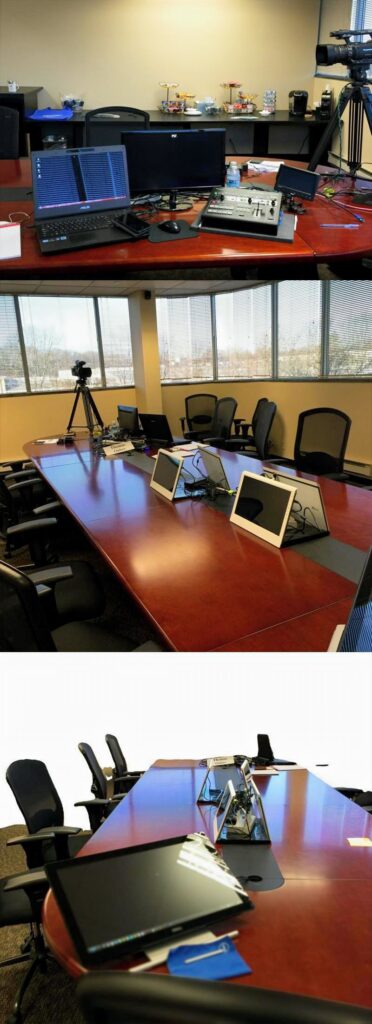
With realtime reporting in place, every question, every answer, every objection, and every discussion appeared almost instantaneously on the computer monitors positioned throughout the room. Everyone with a monitor could follow the testimony as it appeared on the screen.
One benefit that became apparent almost immediately was the additional context that realtime reporting provided. While the interpreters continued listening to the spoken testimony, they could simultaneously follow the developing transcript on the monitor. Rather than relying solely on memory or asking the court reporter to read back portions of the record, they could instantly review the preceding questions and answers as the testimony unfolded. Seeing the testimony in context often made it easier for the interpreters and the witness to recognize when a highly technical engineering term or concept required further clarification before the deposition continued.
At the time, realtime reporting was still in its early stages.
Today’s attorneys are accustomed to lightweight laptops, cloud-based services, wireless networks.
Thirty years ago, none of that existed.
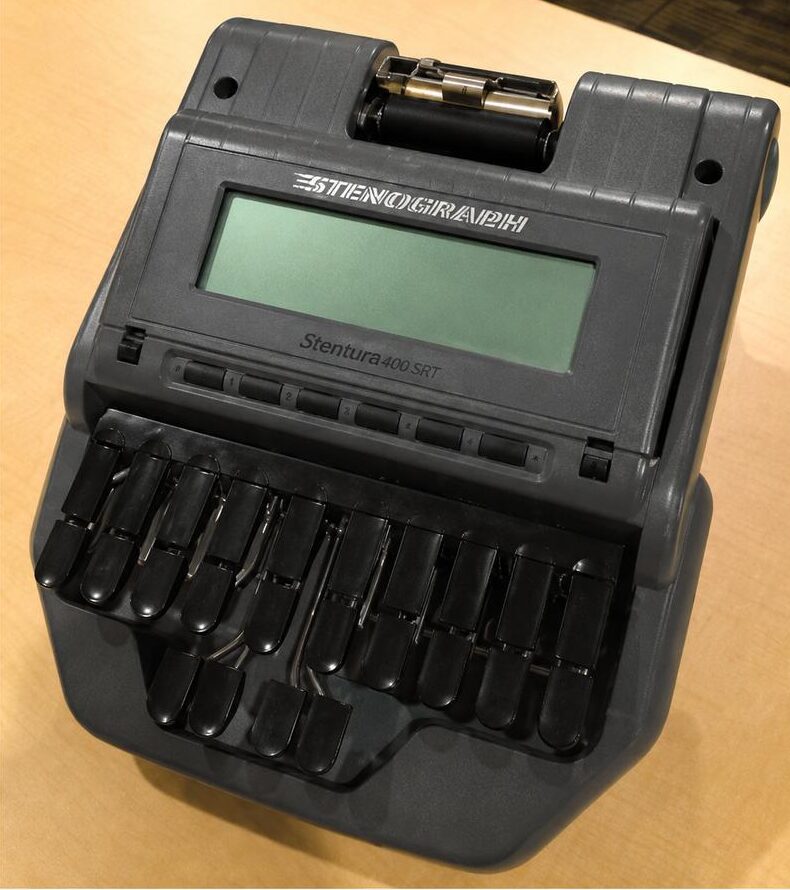
The realtime equipment I transported was considerably larger and far more complex than today’s systems. My stenographic writer connected to my laptop, which then connected to a junction box. From there, multiple RJ-45 network cables ran throughout the deposition room to dedicated monitors positioned for the attorneys, interpreters, witness, and other participants. The setup required numerous cables, adapters, monitors, and careful testing before the deposition could begin.
It certainly wasn’t elegant by today’s standards.
But it worked remarkably well.
Almost instantly, every spoken word appeared on the computer monitors throughout the deposition room.
Today that capability seems routine.
At the time, it represented one of the most exciting advances in litigation technology.
Realtime court reporting was one of the earliest examples of technology fundamentally changing how depositions could be conducted. Long before cloud computing and remote depositions, realtime reporting allowed everyone with a monitor to read testimony as it was being displayed—an extraordinary capability for that era.
This deposition occurred during an important period in the evolution of courtroom presentation systems and litigation support. Additional demonstrations and educational programs are available in our Trial & Deposition Technologies archive. Trial & Deposition Technologies
Why There Were Two Interpreters
To someone unfamiliar with international depositions of experts, the presence of two interpreters might seem unnecessary.
In reality, each interpreter served a distinctly different role.
The official deposition interpreter was responsible for translating every question asked by counsel into Japanese and translating the witness’s answers back into English. Those translations became part of the official deposition record and were relied upon by everyone in the room.
The second interpreter accompanied the Japanese engineering expert as part of the witness’s normal business travel. Retained through an independent interpreting service that regularly worked with the automobile manufacturer, the interpreter had developed a thorough understanding of the company’s technical vocabulary, engineering terminology, manufacturing processes, and product design concepts. Whenever company engineers traveled to the United States—whether for business meetings, technical discussions, or legal proceedings—the same interpreting service was often used because of its familiarity with the specialized language.
Although both interpreters were highly qualified, they served different purposes.
The official deposition interpreter’s responsibility was to provide the formal translation that became the official record.
The second interpreter’s role was to assist the witness by ensuring that highly technical engineering concepts, industry terminology, and specialized vocabulary were accurately understood before the witness responded. Technical terms often do not have a simple word-for-word equivalent in another language, and even slight differences in translation can change the meaning of complex testimony.
Having both interpreters present created an additional level of confidence that the testimony accurately reflected the witness’s intended meaning while preserving the integrity of the official deposition record.
Preparing the Process
What impressed me most was that the preparation began well before the deposition itself.
Whenever engineers from this automobile manufacturer traveled to the United States to testify, Eddie scheduled a preparation session before the deposition.
This wasn’t the traditional witness preparation session where counsel reviews anticipated testimony, exhibits, or likely areas of questioning.
Instead, the purpose was to prepare everyone for the process.
Before a single question was ever asked on the record, the engineer and the accompanying interpreter became familiar with:
- where everyone would be seated,
- how the official interpreter would conduct the translation,
- how the realtime transcript would appear on the computer monitors,
- how the deposition would proceed from beginning to end, and
- how technical translation questions could be identified, discussed, and resolved before an inaccurate interpretation became part of the permanent record.
Looking back, that distinction has remained with me throughout my career.
Eddie wasn’t simply preparing a witness.
He was preparing the entire process.
That level of preparation allowed everyone in the room to focus on the testimony rather than the mechanics of the deposition. It also created an environment where potential communication issues could be recognized and addressed before they affected the accuracy of the record.
Only years later did I fully appreciate what I had witnessed.
It wasn’t simply good organization.
It was thoughtful planning designed to protect the integrity of the deposition from the very beginning.
When Technology Proved Its Value
As testimony progressed, the engineer listened to the interpretation while simultaneously reading the realtime English transcript appearing on the monitor.
The company interpreter did the same.
On more than one occasion, a technical word or phrase prompted discussion because the initial English wording did not fully capture the intended engineering meaning.
Whenever a technical term or engineering concept required clarification, the deposition paused. The discussion took place off the record while the interpreters and the witness worked together to identify the clearest English wording. Once everyone agreed on the appropriate translation, the discussion was summarized on the record and the deposition continued.
That process protected something far more important than convenience.
It protected the integrity of the permanent record.
Without realtime transcription, the witness would not have been able to follow the English wording nearly as effectively.
Without the second interpreter, important technical nuances may have gone unnoticed.
Without the preparation that Eddie had put into the process, the issue may never have been anticipated at all.
Technology Was Never the Story
Looking back today, it would be easy to remember this deposition because of the technology.
The realtime equipment was exciting.
The monitors attracted attention.
The software represented the cutting edge of litigation support.
But technology wasn’t the story.
Preparation was.
Technology simply allowed thoughtful preparation to become even more effective.
Many of these same principles later became part of my technology curriculum for Temple University’s LL.M. in Trial Advocacy program, where students learned how technology supports advocacy—not replaces it. How Teaching Trial Technology Transformed a Generation of Trial Lawyers at Temple’s LL.M. in Trial Advocacy
Lessons I Have Never Forgotten
This deposition taught me lessons that continue to influence how I think about litigation technology today.
The best technology supports people—it never replaces them.
Preparation should include the process, not merely the testimony.
Redundancy is not inefficiency when accuracy is essential.
The permanent record deserves careful protection.
And perhaps most importantly…
Exceptional professionals distinguish themselves by anticipating problems before they occur.
That was Eddie Gray.
Final Thoughts
Over the past 45, almost 50 years, I have watched litigation technology evolve from bulky realtime equipment and dedicated monitors to cloud-based trial platforms, digital evidence presentation, and sophisticated courtroom software.
The tools have changed dramatically.
The principles have not.
Technology remains at its best when it helps professionals communicate clearly, organize information thoughtfully, and preserve the accuracy of the record.
More than 30 years later, I still consider this deposition one of the finest examples I have ever witnessed of preparation, professionalism, and emerging technology working together to serve the interests of justice.
Whenever I think about the evolution of litigation technology, I find myself returning to that deposition—not because of the equipment we used, but because it demonstrated that the best technology succeeds only when it supports careful preparation and experienced professionals.
This article is part of the Lessons from the Trial Room series—firsthand accounts from more than four decades of court reporting, trial technology, legal education, and litigation support. Each article explores the people, preparation, and technology that helped shape modern trial practice.
Many of these early realtime workflows eventually evolved into the multimedia presentation systems, synchronized video techniques, and TrialDirector demonstrations featured throughout the Legal Education, Trial Technology & Professional Archive.
One final historical observation is worth mentioning.
Editor’s Historical Note: Realtime Reporting Beyond the Courtroom
While this article focuses on the use of realtime court reporting during an international expert deposition, many people unknowingly encountered the very same technology outside the legal profession.
During the 1980s and 1990s, television broadcasters began using realtime court reporters to produce live closed captioning for news broadcasts, sporting events, and other live programming. The same realtime technology that attorneys were beginning to use in deposition rooms and courtrooms was simultaneously allowing millions of television viewers to read live captions on their screens.
Today, most people simply turn captions on or off without giving the technology a second thought. Few realize that the foundation for modern live closed captioning was built by court reporters using realtime stenographic equipment and computer-aided transcription systems similar to those described in this article.
The technology has changed dramatically over the years, but its underlying purpose has remained the same: converting spoken words into accurate, readable text almost instantaneously.
— Thomas G. Oakes
Continue Exploring Trial & Deposition Technology
If you enjoyed this article, you may also be interested in:
- Trial & Deposition Technologies — Educational demonstrations, TrialDirector workflows, and courtroom technology history. Trial & Deposition Technologies
- How Teaching Trial Technology Transformed a Generation of Trial Lawyers at Temple’s LL.M. in Trial Advocacy — How technology became part of legal education. Temple LL.M. Trial Technology Article
- Courtroom Technology Archive — Historical courtroom technology, synchronized video, TrialDirector, and litigation support. Courtroom Technology Archive
- Legal News Digest — Current legal technology news and developments affecting the legal profession. Legal News Digest
Interested in the evolution of courtroom technology? Many of the educational programs, courtroom demonstrations, TrialDirector presentations, and litigation technology initiatives referenced throughout this article are preserved in the Legal Education, Trial Technology & Professional Archive, documenting decades of innovation in trial advocacy, legal education, and courtroom communication.
For related background on how trial technology became part of legal education and courtroom advocacy, see: How Teaching Trial Technology Transformed a Generation of Trial Lawyers at Temple’s LL.M. in Trial Advocacy .
Related: Thomas G. Oakes II, Esquire, MBA , whose trial practice reflects many of the preparation and technology principles discussed in this article.
Frequently Asked Questions
What is realtime court reporting?
Realtime court reporting converts a court reporter’s stenographic writing into nearly instantaneous text that appears on computer screens during a deposition or court proceeding.
Why was realtime important in this deposition?
It allowed the engineer and interpreters to read the English testimony as it was created, making it easier to identify and clarify technical translation nuances before they became part of the permanent record.
Why were two interpreters present?
One interpreter served as the official interpreter for the deposition. The second regularly worked with the automobile manufacturer and understood the company’s specialized engineering terminology, providing an additional safeguard for technical accuracy.
What is the biggest lesson from this experience?
Technology is most effective when it supports careful preparation. The realtime system, two interpreters, and advance planning worked together to improve communication and help preserve the integrity of the deposition record.
About the Author — Thomas G. Oakes
Thomas G. Oakes is a 45+ year legal professional in Philadelphia and the founder/editor of PhillyLegalNews.com and PhillyLegalConnect.com. He served for many years as an official court reporter in the Philadelphia Court of Common Pleas and the U.S. District Court for the Eastern District of Pennsylvania, and has worked as a freelance court reporter in state and federal courts for decades.
In addition to courtroom work, Tom is a nationally recognized leader in trial technology. He has trained lawyers, judges, and law students in TrialDirector and courtroom presentation, taught in Temple University’s LL.M. in Trial Advocacy technology curriculum (with special recognition), and has lectured nationally and internationally for organizations including the FDCC and IADC. He also founded the FDCC “FedTech U” program and has instructed in the FDCC Deposition Boot Camp.
Award: Temple University LL.M. in Trial Advocacy — 2013 Faculty Award for “Art of Technology in the Courtroom.”
Tom, prior to his retirement, was the principal of Thomas G. Oakes Associates, a Philadelphia-based litigation-support and trial-technology firm serving attorneys nationwide for more than 33 years.
Disclaimer
This article is for general informational and educational purposes only and does not constitute legal advice. Reading this content does not create an attorney–client relationship. If you need legal advice about a specific situation, consult a qualified attorney in the appropriate jurisdiction.
Readers interested in courtroom technology, legal education, and historical litigation support programs can also explore the Legal Education, Trial Technology & Professional Archive, which documents many of the seminars, technology demonstrations, educational initiatives, and professional collaborations referenced throughout this article.