

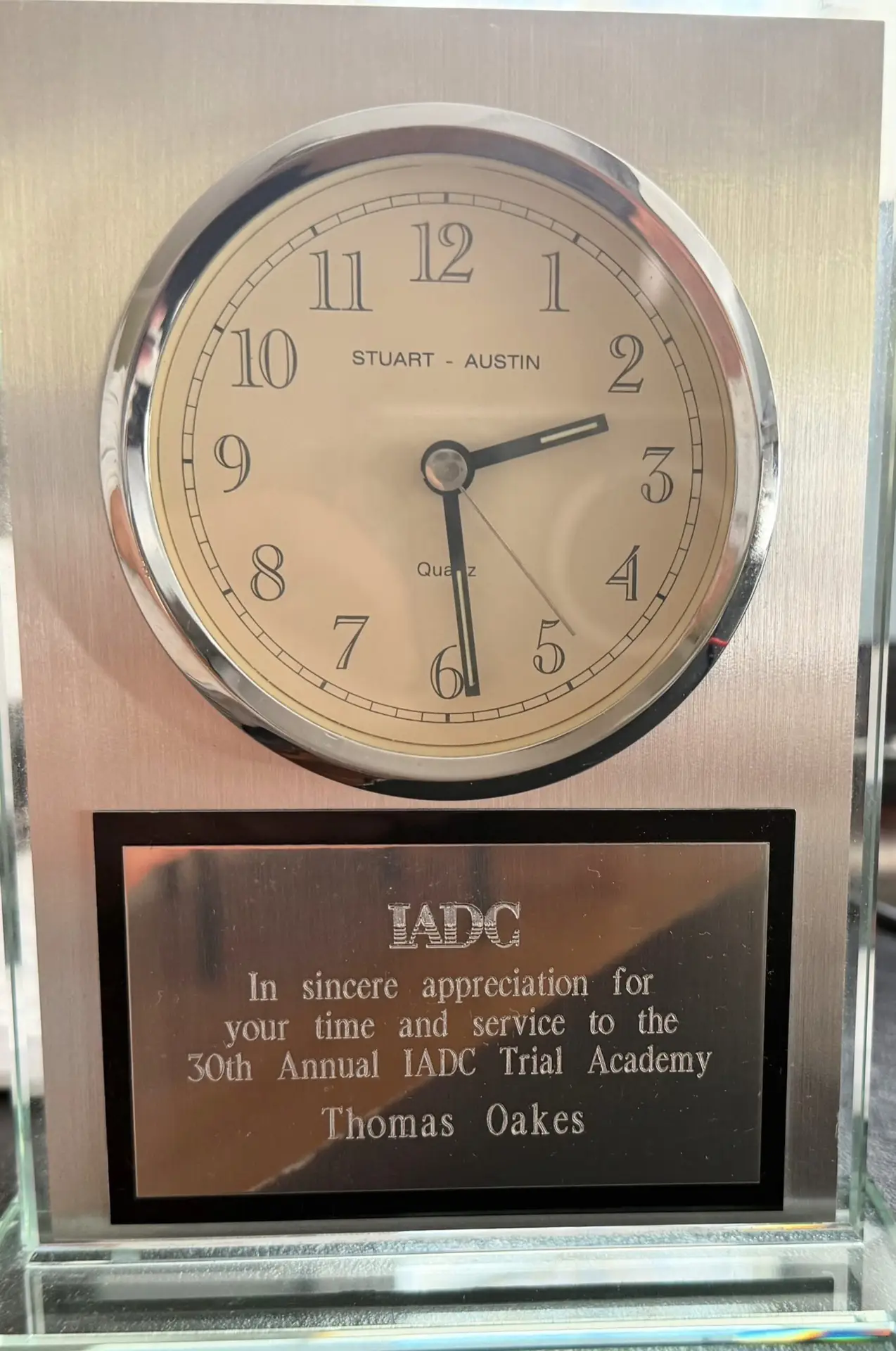
Answer Block
What does the clock from the IADC Trial Academy represent?
The clock represents a professional turning point. It commemorates my role as the court reporter at the IADC Trial Academy in Boulder, Colorado, where I produced same-day final transcripts that let elite trial lawyers review testimony, refine examinations, and improve advocacy in real time. It’s a reminder that great trial work is built quietly through preparation, precision, and trust—long before a jury ever hears a word.The clock represents a professional turning point. It commemorates my role as the court reporter at the IADC Trial Academy in Boulder, Colorado, where I produced same-day final transcripts that allowed elite trial lawyers to review testimony, refine examinations, and improve advocacy in real time. The clock is a reminder that great trial work is built quietly through preparation, precision, and trust—long before a jury ever hears a word.
Key Takeaways
- The IADC Trial Academy is one of the most demanding national trial-training programs in the legal profession.
- Serving as the court reporter placed me at the center of real-time trial refinement through same-day final transcripts.
- Daily transcripts allow trial lawyers to analyze testimony, adjust strategy, and sharpen examinations overnight.
- High-level advocacy depends more on preparation and precision than performance.
- The clock symbolizes the unseen work that supports excellence in the courtroom.
Why are same-day transcripts critical in trial training?
They allow lawyers to immediately review testimony and improve strategy while the work is still fresh.
What role does behind-the-scenes work play in trial advocacy?
It forms the foundation of preparation that determines success long before a case reaches a jury.
The Story Behind the Clock
The clock has been on my wall for years. Most people wouldn’t give it a second look. To them, it’s just a clock.
To me, it marks far more than time. It marks a turning point.
I received it after my participation in the Trial Academy hosted by the International Association of Defense Counsel in Boulder, Colorado—one of the most demanding and respected trial-training programs in the country. The clock wasn’t a trophy or a prize. It was a quiet acknowledgment of work done behind the scenes—work that helped some of the nation’s best trial lawyers sharpen their craft.
I wasn’t a student in the program. I was the court reporter.
Not in the Spotlight—But at the Center of the Work → Behind the Scenes at the IADC Trial Academy
At the Trial Academy, every word matters. Every question, every answer, every pause can shape how a case unfolds before a jury.
My role was to produce same-day final transcripts—daily copy that faculty and participants relied on to review testimony, refine examinations, and sharpen trial techniques in real time. The pace was unforgiving. There was no margin for delay, no tolerance for error.
That kind of work requires precision, stamina, and an understanding of how trials actually function—not in theory, but in practice.
The transcripts weren’t academic exercises. They were tools. Lawyers used them overnight to adjust strategy, rework questioning, and prepare for the next day. The work had to be right, and it had to be ready when they needed it.
Learning by Listening at the IADC Trial Academy
One of the privileges of working at that level is the opportunity to listen—to truly listen—to great trial lawyers at work.
I worked alongside George J. Lavin, Jr., Esquire and Joseph E. O’Neil, Esquire, both of whom brought extraordinary depth and discipline to the program. Watching how experienced advocates dissect testimony, frame narratives, and test arguments was a master class in itself.
One of the participants at the time was Francis J. Grey, Jr., Esquire, now a senior partner at Ricci, Tyrrell, Johnson & Grey. Seeing where careers begin—and where they lead—has always been one of the quiet rewards of this profession. Another participant was Molly H. Craig, Esquire, who was a young attorney with the Hood firm, one of premiere law firms in Charlestown, SC. Molly is also a partner at The Hood Firm.
Looking back, this was one of the first major national programs I worked on with Mr. Lavin. It set the tone for the kind of work I would build my career around: high-level trial advocacy, meticulous preparation, and behind-the-scenes precision.
At the IADC Trial Academy, the standard is simple: prepare at a level where every word can be tested.
The Unseen Foundation of Trial Advocacy
Trials are often remembered for openings, closings, and verdicts. What’s rarely discussed is the infrastructure that makes excellence possible.
Daily transcripts. Accurate records. Immediate access to testimony.
These are not luxuries—they are necessities at the highest level of trial work. They allow lawyers to be deliberate rather than reactive, strategic rather than rushed.
That experience reinforced something I’ve believed throughout my career:
Preparation always outlasts performance.
The strongest advocacy rests on a foundation built quietly, carefully, and long before a jury ever hears a word.
That’s why the IADC Trial Academy emphasizes precision and review—because trial work improves fastest when the record is immediately available.
Why the Clock Still Matters
The clock I received after that program still hangs where I can see it. Not because it’s ornate or sentimental, but because it represents a standard.
I was asked to serve as the court reporter at the IADC Trial Academy because I came from a rigorous court-reporting pedigree and held the highest levels of professional certification in the field. By that point in my career, I had already spent years in both Pennsylvania state courts and the U.S. District Court for the Eastern District of Pennsylvania, where the pace, the stakes, and the standards sharpen a reporter’s craft quickly. I had long been around excellent trial lawyers, and I understood how they prepare—how they test language, how they refine a question, and how they build a record that can withstand scrutiny.
That is why the clock still matters to me. It reminds me of working alongside great lawyers who respected the court reporter’s role—and understood that the record is not an afterthought. A court reporter may be one cog in the wheel, but it is a necessary one: relied upon to capture proceedings accurately, preserve what was said, and ensure that the legal record reflects the truth of what happened in the room.
The importance of making the legal record is not abstract—it is the foundation upon which trial advocacy, appellate review, and public trust in the justice system depend. Please see “Making the Record” on PhillyLegalNews.com.
Frequently Asked Questions
What is the IADC Trial Academy?
The IADC Trial Academy is an intensive national trial-training program designed to refine courtroom skills through live testimony, faculty critique, and real-time practice.
What role does a court reporter play in elite trial programs?
Court reporters provide same-day final transcripts that allow participants to review testimony, evaluate questioning, and adjust trial strategy immediately.
Why are same-day transcripts important in trial preparation?
They give lawyers precise access to the record while testimony is fresh, allowing for overnight refinement and strategic improvement.
Who were some of the professionals involved in this program?
The program included nationally respected trial lawyers such as George J. Lavin, Jr., Esquire and Joseph E. O’Neil, Esquire. One participant at the time was Francis J. Grey, Jr., Esquire, now a senior partner at Ricci, Tyrrell, Johnson & Grey.
What does the clock symbolize today?
It symbolizes a lasting commitment to precision, trust, and preparation—the foundations of effective trial advocacy.
About the Author — Thomas G. Oakes
Thomas G. Oakes is a 45+ year legal professional in Philadelphia and the founder/editor of PhillyLegalNews.com and PhillyLegalConnect.com. He served for many years as an official court reporter in the Philadelphia Court of Common Pleas and the U.S. District Court for the Eastern District of Pennsylvania, and has worked as a freelance court reporter in state and federal courts for decades.
In addition to courtroom work, Tom is a nationally recognized leader in trial technology. He has trained lawyers, judges, and law students in TrialDirector and courtroom presentation, taught in Temple University’s LL.M. in Trial Advocacy technology curriculum (with special recognition), and has lectured nationally and internationally for organizations including the FDCC and IADC. He also founded the FDCC “FedTech U” program and has instructed in the FDCC Deposition Boot Camp.
Award: Temple University LL.M. in Trial Advocacy — 2013 Faculty Award for “Art of Technology in the Courtroom.”
Tom, prior to his retirement, was the principal of Thomas G. Oakes Associates, a Philadelphia-based litigation-support and trial-technology firm serving attorneys nationwide for more than 33 years.
Disclaimer
This article is for general informational and educational purposes only and does not constitute legal advice. Reading this content does not create an attorney–client relationship. If you need legal advice about a specific situation, consult a qualified attorney in the appropriate jurisdiction.
S