
Philly Legal News
  • Home
  • About the Editor
  • Feature
  • Blog
  • News Updates & Technology
  • INSIGHTS
    • Silent Advocacy: The Hidden Force Behind Trial Success
  • Contact
  • Legal News Digest — From the Courts & Legal Community
No Result
View All Result
  • Home
  • About the Editor
  • Feature
  • Blog
  • News Updates & Technology
  • INSIGHTS
    • Silent Advocacy: The Hidden Force Behind Trial Success
  • Contact
  • Legal News Digest — From the Courts & Legal Community
No Result
View All Result
Philly Legal News
No Result
View All Result
Home Legal Analysis

Chapter IV: The Final Pre-Trial Meeting with the Court

Thomas Oakes by Thomas Oakes
April 11, 2026
in Legal Analysis, Trial Tips
0
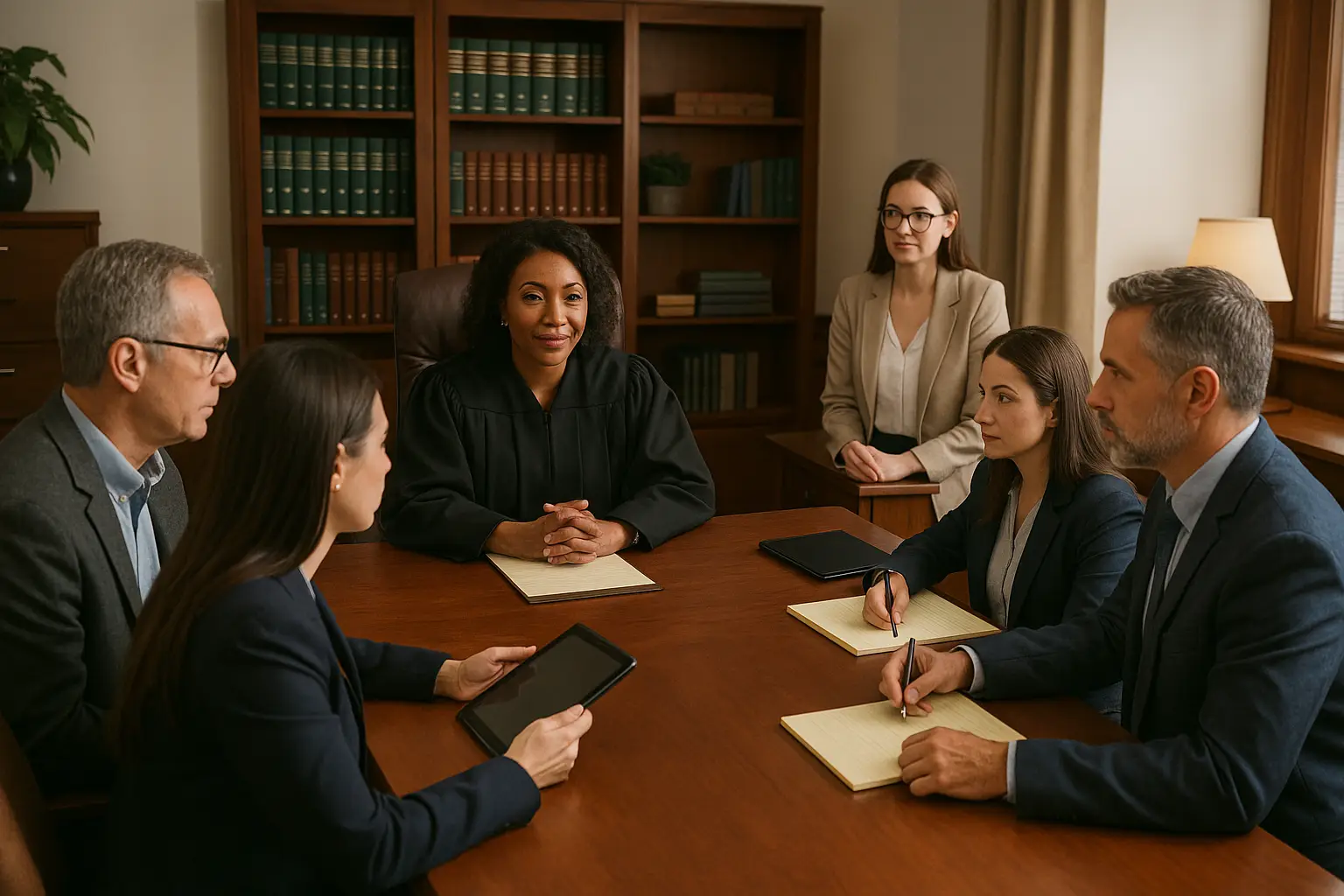
Judge meeting with attorneys during final pre-trial conference — Silent Advocacy Series, Philly Legal News

A judge meets with counsel and clerks during the final pre-trial conference — a key moment to practice Silent Advocacy

0
SHARES
21
VIEWS
Share on FacebookShare on Twitter

Silent Advocacy Series – Teachings of George J. Lavin Jr., Esquire and Chilton Davis Varner, Esquire

Introduction

When the trial date approaches, the final pre-trial meeting with the Court becomes your last opportunity to shape how efficiently the trial will unfold. It’s also the ideal moment to practice Silent Advocacy — persuasion through preparation, tone, and professionalism rather than argument.

In many jurisdictions, this meeting marks your first direct encounter with the trial judge. It’s your chance to show that you’ve organized the case, mastered the local rules, and are committed to helping the Court run a fair and seamless proceeding.


Purpose of the Final Pre-Trial Meeting

The pre-trial conference isn’t about argument — it’s about alignment. The clearer you are on logistics, jury selection, motions, and scheduling, the fewer disruptions will occur once the jury is seated.

When appearing pro hac vice, coordinate early with local counsel so the judge never asks:

“Counsel, why are you raising this now? Didn’t you ask your local counsel first?”

Missteps like this can erode credibility. Silent Advocacy thrives on anticipation and procedural respect.


Key Goals of Silent Advocacy at the Conference

  • Clarity: Surface potential legal issues before jury selection.
  • Predictability: Confirm the judge’s expectations for voir dire, exhibits, objections, and jury instructions.
  • Record Protection: Learn how offers of proof will be handled to preserve the appellate record.
  • Civility & Efficiency: Demonstrate that your goal is to assist the Court, not complicate proceedings.

Checklist for the Final Pre-Trial Meeting

A. Jury Selection and Juror Logistics

  • Identify unresolved legal issues.
  • Determine whether the judge or attorneys conduct voir dire.
  • Clarify if juror questionnaires are allowed and whether joint proposals are accepted.
  • Confirm what jurors will be told about schedule and trial length.
  • Understand hardship protocols and selection of alternates.
  • Review note-taking and foreperson selection procedures.

B. Trial Structure and Order of Proof

  • Establish the order of presentation among multiple parties.
  • Confirm time limits on openings, directs, and crosses.
  • Submit the trial brief if requested.
  • Determine when jury instructions are due and how to preserve objections.

C. Evidence Management and the Appellate Record

  • Learn the Court’s preferred offer-of-proof format.
  • Review exhibit-marking, exchange, and introduction procedures.
  • Plan for newly discovered cross-examination exhibits.
  • Ask about using demonstrative, trial technology or AV materials.
  • Confirm whether a jury view will be allowed.

Practice Tip: Draft a one-page offer-of-proof memo for each witness. Even if unused, it sharpens admissibility and record-preservation strategy.

D. Sidebars, Objections and Record Control

  • Confirm whether sidebar conferences are allowed and recorded.
  • Clarify objection protocol and speaking-objection limits.
  • Determine whether next-day witnesses must be disclosed daily.

E. Motions, Science Issues and Verdict Procedure

  • Identify any Daubert or Frye issues and how they’ll be resolved.
  • Confirm the required percentage for a verdict and whether unanimity applies.
  • Review verdict-form preferences and opportunities to propose formats.

F. Courtroom Boundaries and Scheduling

  • Know where counsel may stand or approach witnesses.
  • Understand the judge’s schedule, holidays, and motion days.
  • Ask about opening-statement boundaries and bifurcation options.

Tone and Technique: Practicing Silent Advocacy

Begin the conference with collaboration:

“Your Honor, we’ve prepared a concise agenda to ensure the trial runs efficiently. May we proceed through it?”

Keep every statement solution-focused:

  • “We’re aligned with local counsel on all procedural points.”
  • “If the Court prefers, we can submit a clean verdict form for review.”
  • “We’d like to confirm the sidebar-transcription procedure to protect the record.”

Every line of dialogue should build trust and demonstrate mastery — without ego.


Technology and Preparation Tools

  • Use a timeline program such as TimelinePad or TrialLine – Legal Timeline Software.
  • Prepare digital exhibit binders or QR-coded indexes for bench and reporter.
  • Maintain a one-page protocol sheet listing rulings, witness order, and objections.

Editor’s Note

This article is part of the Silent Advocacy Series on Philly Legal News, exploring courtroom strategy and trial-management techniques inspired by the teachings of George J. Lavin Jr., Esquire and Chilton Davis Varner, Esquire.


This article is part of our Silent Advocacy Series. For more lessons on courtroom strategy, trial preparation, credibility, and real-world examples of Silent Advocacy in action, visit the hub: Silent Advocacy Series — Lessons from the Courtroom →




Frequently Asked Questions

What is the final pre-trial meeting with the Court?

It’s a conference with the trial judge before trial to confirm logistics, rules, jury selection, exhibits, and time limits.

Can I use juror questionnaires?

Often yes — if both sides consent and the judge approves a joint form.

How are offers of proof handled?

Some courts accept deposition excerpts; others require live testimony outside the jury’s presence. Always confirm the judge’s preference.

When should jury instructions be submitted?

Varies by judge — some before trial, others after evidence closes. Clarify early.

Will the court limit openings or cross-examinations?

Possibly. Many judges impose time limits; plan your outlines accordingly.

Are sidebar conferences recorded?

Not automatically. Ask the court reporter beforehand and request transcription if needed.

This article is part of our Silent Advocacy Series. For more lessons on courtroom strategy, trial preparation, credibility, and real-world examples of Silent Advocacy in action, visit the hub: Silent Advocacy Series — Lessons from the Courtroom →

Tags: George J. Lavin Jr.silent advocacytrial advocacyTrial Preparationtrial tips
Thomas Oakes

Thomas Oakes

Related Posts

Independence Hall Philadelphia where May 1986 naturalization ceremony was held
Legal Analysis

A Spring Day of New Citizens at Independence Hall (May 1986)

February 16, 2026
PCFFF (“PC Triple-F”) post-collision fuel-fed fire — vehicle product liability cases
Depositions

PCFFF (“PC Triple-F”): The Post-Collision Fuel-Fed Fire Cases That Launched My Firm and Career

February 16, 2026
George J. Lavin, Jr., Edward A. Gray, and Thomas G. Oakes II — mentors whose guidance shaped a trial lawyer before his first case
About

Before the First Case: How Mentorship Shapes a Trial Lawyer

February 14, 2026

Browse By Category

  • About (4)
  • Court Rulings (1)
  • Criminal (1)
  • Depositions (7)
  • Feature (5)
  • Legal Analysis (14)
  • Legal History (6)
  • Legal Lecture Series (4)
  • Legal Lecture Series (2)
  • News Updates & Technology (9)
  • Recent Verdicts (1)
  • Technology & Litigation Support (17)
  • Trial Tips (26)
  • Trending
  • Comments
  • Latest
Independence Hall Philadelphia where May 1986 naturalization ceremony was held

A Spring Day of New Citizens at Independence Hall (May 1986)

February 16, 2026
trialpad - trial presentation

Mastering Trial Presentation with TrialPad: A Deep Dive into the LIT SUITE

July 24, 2025
Silent Advocacy book cover with IADC branding and the title "Practical Points for the Trial Attorney" on a blue gradient background

The Lavin Method: Silent Advocacy as Legacy and Trial Strategy

April 12, 2026
Edward A. Gray reputation lesson demonstrated by water pouring from a bottle onto a table during a legal teaching moment

You Can’t Put the Water Back: A Lesson on Reputation I Will Never Forget

February 14, 2026
Philadelphia City Hall with overlaid text 'Welcome to PhillyLegalNews – Just Facts. No Opinions.

Welcome to PhillyLegalNews – Just Facts. No Opinions.

0
Trial Tips That Still Matter – Court reporter best practices from the IADC archives

Trial Tips That Still Matter: Court Reporter Best Practices from the IADC Archives

0
Modern deposition setup with synced video, digital exhibits, and real-time transcription tools

How Technology Changed Depositions: What Lawyers Must Know

0
Generational jury traits chart comparing GI, Silent, Baby Boomers, Gen X, Millennials, and Gen Z by age, major events, and courtroom behavior traits.

Blending Trial Technologies: Reaching Today’s Jurors Where They Are

0
Independence Hall Philadelphia where May 1986 naturalization ceremony was held

A Spring Day of New Citizens at Independence Hall (May 1986)

February 16, 2026
PCFFF (“PC Triple-F”) post-collision fuel-fed fire — vehicle product liability cases

PCFFF (“PC Triple-F”): The Post-Collision Fuel-Fed Fire Cases That Launched My Firm and Career

February 16, 2026
courtroom story showing an elder attorney’s scuffed shoes during a closing argument, a moment no transcript captures

A Courtroom Story the Transcript Could Never Tell

February 14, 2026
George J. Lavin, Jr., Edward A. Gray, and Thomas G. Oakes II — mentors whose guidance shaped a trial lawyer before his first case

Before the First Case: How Mentorship Shapes a Trial Lawyer

February 14, 2026

Sign Up For Our Newsletter


Recent News

Independence Hall Philadelphia where May 1986 naturalization ceremony was held

A Spring Day of New Citizens at Independence Hall (May 1986)

February 16, 2026
PCFFF (“PC Triple-F”) post-collision fuel-fed fire — vehicle product liability cases

PCFFF (“PC Triple-F”): The Post-Collision Fuel-Fed Fire Cases That Launched My Firm and Career

February 16, 2026
courtroom story showing an elder attorney’s scuffed shoes during a closing argument, a moment no transcript captures

A Courtroom Story the Transcript Could Never Tell

February 14, 2026
George J. Lavin, Jr., Edward A. Gray, and Thomas G. Oakes II — mentors whose guidance shaped a trial lawyer before his first case

Before the First Case: How Mentorship Shapes a Trial Lawyer

February 14, 2026
Philly Legal News

Philly Legal News is a web magazine focused on Philadelphia’s legal marketplace, covering litigation updates, legal technology, court rulings, and industry news.

Follow Us

Browse by Category

  • About
  • Court Rulings
  • Criminal
  • Depositions
  • Feature
  • Legal Analysis
  • Legal History
  • Legal Lecture Series
  • Legal Lecture Series
  • News Updates & Technology
  • Recent Verdicts
  • Technology & Litigation Support
  • Trial Tips

Recent News

Independence Hall Philadelphia where May 1986 naturalization ceremony was held

A Spring Day of New Citizens at Independence Hall (May 1986)

February 16, 2026
PCFFF (“PC Triple-F”) post-collision fuel-fed fire — vehicle product liability cases

PCFFF (“PC Triple-F”): The Post-Collision Fuel-Fed Fire Cases That Launched My Firm and Career

February 16, 2026

Sign Up For Our Newsletter


  • Home
  • About the Editor
  • Feature
  • Blog
  • News Updates & Technology
  • INSIGHTS
  • Contact
  • Legal News Digest — From the Courts & Legal Community

© 2025 Philly Legal News

No Result
View All Result
  • Home
  • About the Editor
  • Feature
  • Blog
  • News Updates & Technology
  • INSIGHTS
    • Silent Advocacy: The Hidden Force Behind Trial Success
  • Contact
  • Legal News Digest — From the Courts & Legal Community

© 2025 Philly Legal News