


“Preparation is the be-all of good trial work. Everything else—felicity of expression, improvisational brilliance—is a satellite around the sun. Thorough preparation is that sun.”
— Louis Nizer (1973)
When trial is still months away, it’s tempting to think the real work hasn’t yet begun. In reality, the time between case filing and the final pre-trial conference is when the foundation for trial success—or disaster—is laid.
In Silent Advocacy, George J. Lavin, Jr. makes it clear: the lawyers who prepare early eliminate emergencies before they happen. This installment of The Lavin Method focuses on how to use your early pre-trial phase to organize, assign, and equip your team so that when the case finally comes before a jury, you are fully prepared.
Why Early Preparation Changes Everything
Some lawyers treat trial as an emergency to be managed only once it’s imminent. Lavin rejects that mindset. Preparation is not a last-minute scramble—it’s a disciplined, ongoing process.
Work done effectively from the start of the pre-trial phase:
- Keeps the trial team focused on meaningful preparation instead of chasing last-minute details.
- Boosts team morale because every member knows their role.
- Reduces wasted time on redundant or unnecessary work.
If you are the lead trial attorney, ensure that every member of your team knows their responsibilities early—and that includes legal assistants, paralegals, associates, trial technicians, and outside consultants.
Ditch the “Lone Warrior” Mentality
The romantic notion of a lone attorney conquering the courtroom is just that—romantic. In real life, trial work is too complex for one person to do it all well. Lavin stresses the importance of relying on skilled professionals to carry portions of the load.
Pro tip: Assign roles now, not later. By clarifying responsibilities months in advance, you’ll avoid duplicating work, missing critical tasks, or burning out your lead counsel before trial even starts.
Organize Your Files Like Your Case Depends on It (Because It Does)
File organization is deceptively simple—and too often overlooked. Lavin emphasizes that the ultimate test of preparation is whether you can instantly produce any document the court requests.
Your file system should:
- Be comprehensive and indexed—every pleading, exhibit, and deposition transcript accounted for.
- Include a clean chronology—your case’s backbone.
- Mirror paper and digital files—keep a “hot docs” set in both formats.
- Be backed up securely—Murphy’s Law applies in court.
Producing a document quickly in court signals to the judge and jury that you respect their time and are fully prepared. Watching your opponent fumble for a document sends the opposite message.
📌 For more on organizing evidence for trial, see our post on Making the Legal Record.
The Case for an Off-Site “War Room”
For significant trials, Lavin recommended working from a hotel room or dedicated space close to the courthouse. Distractions disappear, focus sharpens, and the environment becomes trial-oriented.
I saw this approach first-hand. Even though Mr. Lavin’s law office was in Philadelphia, he always set up a war room at a hotel close to the courthouse. It wasn’t just a staging area—it was a fully functioning trial command center. Witnesses were provided work areas and sleeping accommodations. Each day’s proceedings were transcribed, and daily copy was made available to the entire team for immediate review. The room was meticulously organized, with secretaries and paralegals working side-by-side with attorneys.
Lavin’s partner, Edward A. Gray, Esquire—a remarkable trial attorney and one of the founding members of Lavin, Coleman, Finarelli & Gray—took a slightly different approach. As Ed once told me, “Tom, I am not going to war. I am telling my client’s story.” His cases were often incredibly complex, and he prepared with equal intensity.
I worked with Ed on a case where he developed three different defense strategies, anticipating moves from one of Philadelphia’s most formidable plaintiff’s firms. Like Lavin, Eddie set up his “trial room” off-site, equipped with secure phone lines, photocopiers, printers, desks, and every tool needed to run a fully functioning law office.
In your war room, post:
- Next-day trial schedule.
- Contact sheets with all phone numbers and emails.
- Transport times for getting to court.
- Daily gear checklist with assigned responsibility.
- The “Four Easels” (covered in Part 2).
📌 For courthouse details, attorneys can visit the First Judicial District of Pennsylvania website.
Solve Logistics Before They Become Problems
Courtrooms vary widely in size, layout, and tech compatibility. Lavin urges trial teams to solve these issues before the first day of trial.
Questions to answer now:
- Will your exhibits fit through courthouse doors?
- Are there restrictions on your tech setup?
- Do you have enough electrical access?
- Will there be a jury view to arrange?
📌 Review local court technology guidelines such as those from the U.S. District Court for the Eastern District of Pennsylvania.
Silent Advocacy in Trial Tech Preparation
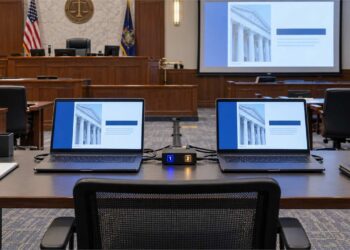
As part of my own Silent Advocacy work, I always schedule a courthouse visit before trial. I meet with the courtroom deputy, check in with the court reporter, and deliver all exhibits digitally—fully labeled with trial exhibit numbers and an index.
During these visits, I:
- Plan projector and TV placement.
- Coordinate cable taping and power routing.
- Arrange monitor placement for counsel tables and the Judge.
- Provide staff and law clerks with the tech setup plan.
Early cooperation with court staff scores Silent Advocacy points—and those points matter.
The “Must Be Answered” Board
One of Lavin’s simplest but most effective tools is a prominently placed whiteboard in the war room labeled MUST BE ANSWERED.
Every new issue—unexpected testimony, opponent arguments, or unresolved legal questions—goes on the board until it’s addressed.
Discovery Review: No Surprises
Use this time to review discovery:
- Are there missing documents?
- Should you amend any responses?
- Can you streamline interrogatory answers for the jury?
📌 For state-level procedures, see the Unified Judicial System of Pennsylvania Rules.
Why This Matters for Attorneys
Trial preparation means adapting to courtroom realities—different judges, layouts, and juror expectations. Lavin’s disciplined method ensures you’re never caught unprepared.
Whether your case is in a county courthouse or federal court, early organization, clear roles, and logistical planning keep your focus where it belongs—on telling your client’s story.
Coming in Part 2
We’ll cover The Four Easels—“Must Be Answered,” “Agrees,” “Assignments,” and “Things to Say in Closing”—plus Lavin’s daily team debrief strategy.
More from The Lavin Method:
- Lesson 1 – Silent Adv📘 Silent Advocacy Series: Lesson 1ocacy
- Lesson 2 – Should You Take a Civil Case to Trial or Settle?
- Chapter 3 (Part 2) coming soon
Disclaimer: This article is for informational purposes only and does not constitute legal advice. PhillyLegalNews is not a law firm and does not provide legal representation.