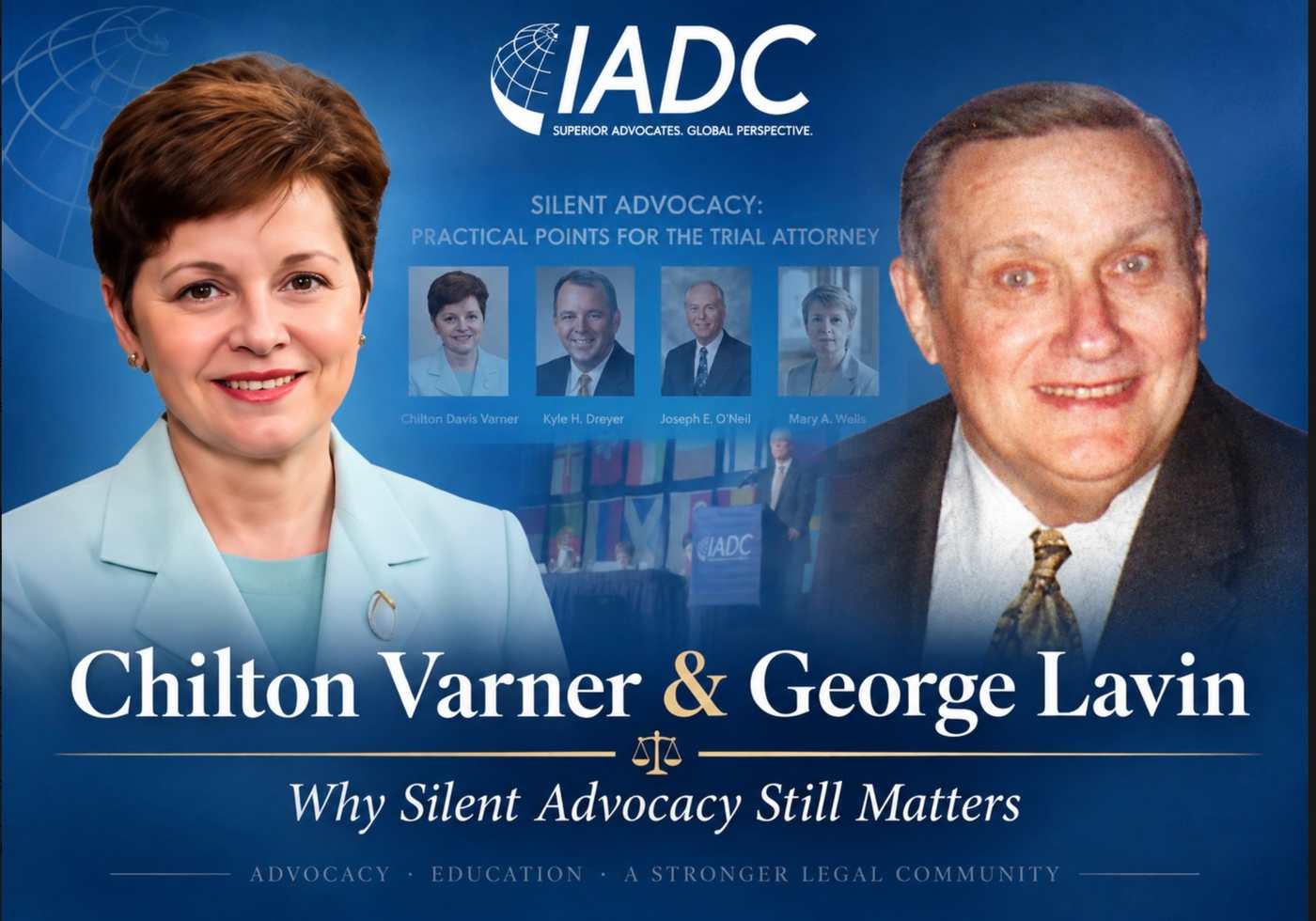
The 2015 George Lavin memorial brought together moderator Chilton Davis Varner and panelists Mary A. Wells, Joseph E. O’Neil and Kyle H. Dreyer to share enduring lessons from Silent Advocacy.
Part of the PhillyLegalNews Silent Advocacy Library
Explore the history, courtroom lessons and continuing influence of George J. Lavin, Jr. and Chilton Davis Varner’s Silent Advocacy.
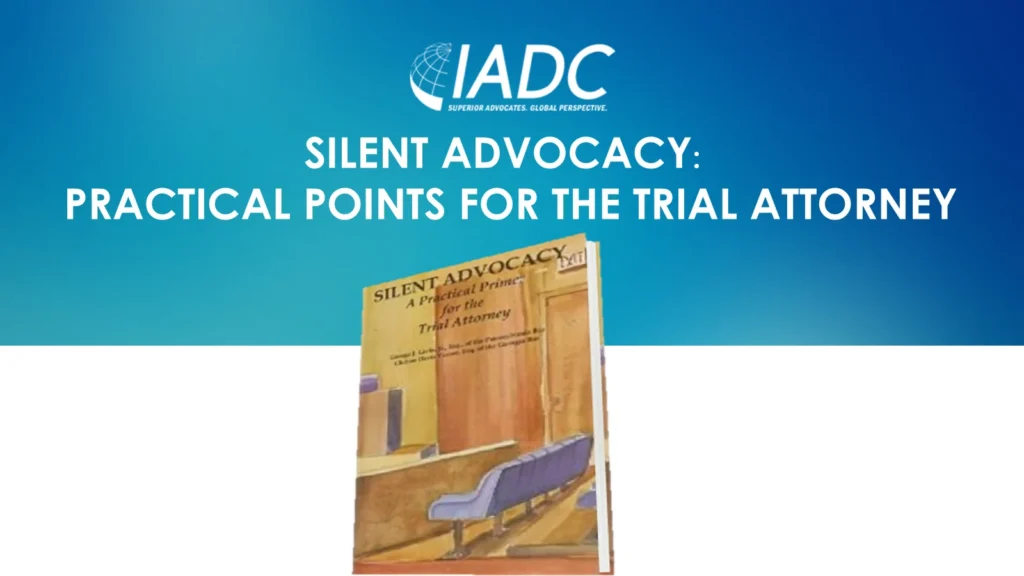
The invitation brought together two accomplished trial lawyers and produced Silent Advocacy: A Practical Primer for the Trial Attorney. My own copy bears their 2006 copyright and a handwritten dedication from George—a personal reminder of the friendship and teaching behind these pages.
Twenty years later, the lessons still deserve an audience.
Lavin passed away in 2014. About a year later, a remarkable group of trial lawyers gathered for an International Association of Defense Counsel program devoted to his memory and, fittingly, to the teaching of trial practice.
The program was titled “Silent Advocacy: Practical Points for the Trial Attorney.” The IADC’s 2015 Annual Meeting program identifies Varner as moderator and names the three speakers.
The memorial offered a historical look at a particular approach to trying cases—where it came from, how it was taught, how accomplished trial lawyers incorporated its principles into their own styles, and how those principles could be carried forward.
That history remains relevant today.
Courtrooms have changed. Trial technology has changed dramatically. The tools lawyers use to prepare and present cases continue to evolve.
But jurors are still people.
Preparation, credibility, respect and the ability to teach a jury remain fundamental to trial advocacy.
The opening slide from the 2015 IADC George J. Lavin, Jr. memorial program, featuring Silent Advocacy: A Practical Primer for the Trial Attorney.
Chilton Davis Varner: Co-Author, Trial Lawyer and Teacher
Chilton Davis Varner deserves a central place in the history of Silent Advocacy.
She was not simply the moderator of the George Lavin Memorial program. She was Lavin’s co-author, an exceptional trial lawyer in her own right, and an important participant in preserving, practicing and teaching the principles the two had put into book form. The 2015 George Lavin memorial program carried those lessons forward, with Varner and three fellow trial lawyers sharing what they had learned from him.
In opening the memorial program, Varner explained that Lavin had asked her in 2006 to join him in putting the lessons from his Silent Advocacy lectures onto paper.
She described the resulting book as a “labor of love” for both of them.
Her professional background makes that collaboration especially significant. Varner built a national practice involving product liability, mass tort and complex commercial litigation. She also served on the Federal Civil Rules Advisory Committee and was President of the American College of Trial Lawyers in 2012–13. King & Spalding biography.
This was not simply theory being preserved on paper. These were principles being discussed and applied by lawyers who regularly handled difficult litigation in courtrooms around the country.
The George Lavin Memorial Panel – An Extraordinary Panel of Trial Lawyers
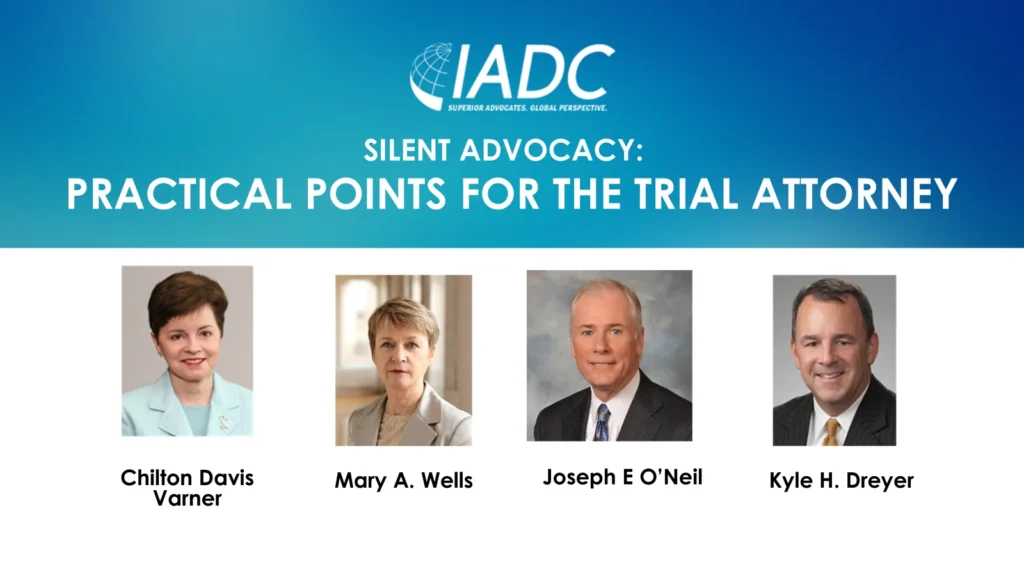
The 2015 IADC memorial panel: Chilton Davis Varner, Mary A. Wells, Joseph E. O’Neil, and Kyle H. Dreyer, from left to right.
The caliber of the lawyers participating in the memorial program says a great deal about both Lavin’s influence and the seriousness with which his teaching was regarded.
Joining Chilton Davis Varner were Joseph E. O’Neil, Mary A. Wells and Kyle H. Dreyer, whose careers connected courtroom practice with teaching and mentorship.
Each brought substantial courtroom experience to the discussion.
He had been Lavin’s associate and later his partner in Philadelphia. His IADC biography describes more than 30 years of courtroom experience defending major corporations in complex litigation, including product liability, mass tort, medical-device and commercial matters.
O’Neil served as national counsel for major pharmaceutical, automotive, health and life-sciences companies and as lead trial counsel in state and federal courts throughout the United States. Varner introduced him as the new IADC president; he served for 2015–16 and is a Fellow of the American College of Trial Lawyers. IADC biography.
Mary A. Wells
Mary A. Wells brought another distinguished national trial practice to the panel.
She founded Wells, Anderson & Race in Denver in 1995 and developed a national practice involving complex litigation, including product liability and business matters. She became a Fellow of the American College of Trial Lawyers and received the John P. Raleigh Award from the Product Liability Advisory Council. Thompson Coe historical profile.
Varner also noted an important connection to trial teaching: Wells had led an IADC Trial Academy faculty on which Varner and O’Neil participated.
Kyle H. Dreyer
Kyle H. Dreyer brought decades of national trial experience of his own.
Dreyer was a founding partner of Hartline Dacus Barger Dreyer LLP, where he served on the firm’s management committee. IADC materials describe him as having served as lead trial counsel in virtually every state and having successfully tried complex cases in numerous jurisdictions. His practice included significant product-liability and corporate litigation.
After retiring from the firm, Dreyer became Program Coordinator and an adjunct professor for Baylor Law School’s Executive LL.M. in Litigation Management and continued teaching in Baylor’s Practice Court program, as documented in his 2022 IADC biography.
A Memorial Built Around Teaching
The speakers honored their friend by doing something he valued: teaching trial advocacy.
The program itself was structured around trial practice:
Mary Wells — Direct Examination
Joseph O’Neil — Cross-Examination
Kyle Dreyer — Closing Argument
Chilton Davis Varner provided the historical and philosophical introduction
She told the audience that the four panelists shared a common heritage: George Lavin had been a mentor and teacher.
But she was equally careful to explain that they were different lawyers—with different approaches, different styles and, as she put it, even “different accents.”
That observation captures something important about Silent Advocacy.
Lavin taught principles that lawyers could incorporate into their own advocacy: preparation, mastery of the evidence, credibility, respect and judgment. Those principles could endure while the lawyers applying them retained their individual styles.
“Empower the Jury”
Varner illustrated that process with one of the most important lessons Lavin taught her personally.
As a younger trial lawyer, she believed one of her principal responsibilities in opening statement and closing argument was to convince the jury that her interpretation of the case was the correct one.
Then Lavin asked to read transcripts of one of her opening statements and closing arguments.
When they next spoke, Lavin told her that she was a good advocate—but he thought she was working too hard to convince the jury that the case could come out only one way.
Then came the lesson:
“Empower the jury.”
George J. Lavin, Jr.’s advice, recalled by Chilton Davis Varner in her written introduction to the 2015 IADC memorial program.
Lavin’s reasoning was practical.
Her account emphasized that jurors have real factual questions to resolve. The advocate’s task includes helping them understand those questions and the evidence bearing on them.
Those factual decisions belonged to the jurors. Lavin suggested identifying the important questions openly, explaining that those questions were theirs to decide, and giving them the evidence and room they needed to do their job.
What Chilton Did With the Lesson
Chilton Davis Varner’s account is especially valuable because she put the advice into practice.
In her next trial, she structured her opening around three or four factual issues the jury would ultimately have to resolve.
She previewed the evidence on both sides relating to those issues.
Then, in closing argument, she returned to those same questions and reviewed the evidence bearing upon them.
But the decisions remained where they belonged—with the jury.
Varner said the approach was liberating, and she incorporated it into her own trial practice.
That is a useful example of how Silent Advocacy was passed from lawyer to lawyer: not as a script to be copied, but as a principle to be understood and adapted.
Continuing the Teaching of Silent Advocacy
Lavin’s advice remains useful because it gives lawyers a practical task: identify the questions jurors must decide, organize the evidence around those questions, and help them reach an informed judgment.
Modern presentation tools can support that work. A clear timeline, a well-chosen exhibit or synchronized video testimony can make difficult evidence easier to follow. Their value depends on the preparation and judgment behind them.
Chilton Davis Varner helped preserve these principles as Lavin’s co-author and showed how she adapted them in her own trial practice. At the 2015 memorial, she and her fellow panelists carried that work forward through lessons in direct examination, cross-examination and closing argument.
It was about continuing the teaching.
That purpose also guides the PhillyLegalNews Silent Advocacy Library: preserving the history, examining the lessons chapter by chapter, and considering how they apply in today’s courtrooms.
Editor’s Note — Thomas G. Oakes
I had the privilege of knowing and working with George J. Lavin, Jr.—“Lav,” as I came to call him—beginning during my years as an official court reporter in the United States District Court for the Eastern District of Pennsylvania in Philadelphia.
Our friendship continued through the later years of his practice, his retirement, and his continuing philanthropic work on behalf of the Augustinians at Villanova.
My connection to Silent Advocacy was also more direct.
Lav interviewed me from the perspective of an official court reporter who had spent years sitting through trials, motions and hearings and watching lawyers practice every day in the courthouse.
He wanted to know what court reporters and other courtroom professionals noticed about lawyers and firms who handled themselves particularly well before and during trial—how they prepared, how they treated court personnel, and what distinguished lawyers who understood that everyone in the courtroom had a role in the process.
Some of my observations, comments and ideas were incorporated into the portion of Silent Advocacy dealing with respecting and working with court officials.
That experience gave me an especially close view of what Lav was trying to teach.
Effective advocacy does not begin when a lawyer stands to make an opening statement. It begins much earlier—with preparation, professionalism, credibility and respect for the people who make the courtroom work.
I was pleased to help behind the scenes with the George Lavin memorial program, which Thomas G. Oakes Associates sponsored. Working from the panelists’ materials, I created and assembled the slide deck, including the opening slide featuring the cover of Silent Advocacy, the panel introduction and the Lavin family photographs. It was a meaningful opportunity to support the speakers as they remembered George and shared his teaching.
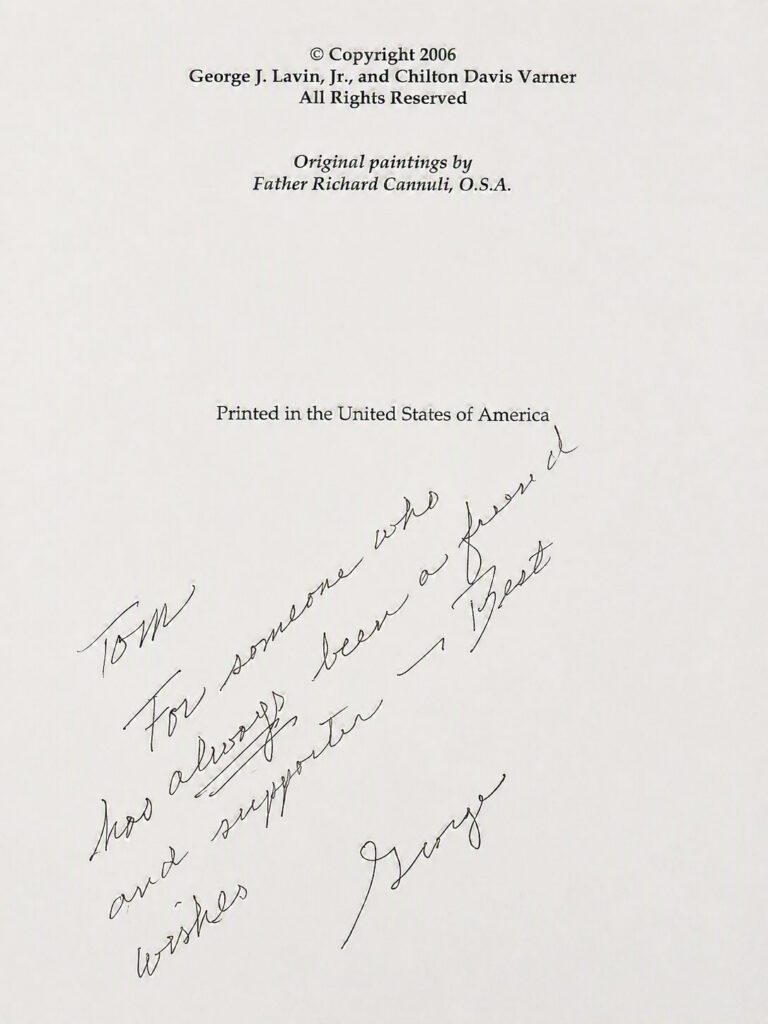
My copy of Silent Advocacy carries a personal inscription from George:
“Tom — For someone who has always been a friend and supporter — Best wishes, George.”
The copy of Silent Advocacy George gave me, inscribed: “Tom — For someone who has always been a friend and supporter — Best wishes, George.”
A Mentor to the Next Generation of Our Family
Mr. Lavin’s influence also reached the next generation of my family.
He was a mentor to my son, Thomas G. Oakes II, Esquire, MBA, as Tom prepared for and pursued his legal education. Lav wanted Tom to attend Villanova University School of Law. Villanova held particular meaning for Lav through his work helping the Augustinians, and he took a personal interest in Tom’s path into the profession.
While attending law school, Tom also began working toward his MBA. He received his law degree first and completed his MBA within the following year.
George also wanted Tom to spend a summer interning with Edward A. Gray, Esquire. That opportunity became an important professional relationship: Tom served as Ed’s summer intern and later became his associate.
Ed’s mentorship continued after Tom established his own practice. They continued speaking weekly, maintaining a relationship that had grown from a summer internship into years of professional guidance.
For our family, these relationships are an enduring part of Mr. Lavin’s legacy. He helped guide Tom toward his education and toward a lawyer who would continue mentoring him as his career developed, and well beyond.
My son now practices through The Oakes Firm. Looking back, I see the same commitment to the next generation that Chilton described in her remarks: experienced lawyers making time to teach, offer guidance and help a young lawyer find his way.
Continue Exploring the Silent Advocacy Library
For readers new to this body of work, this article can serve as the historical introduction before moving into the chapter-by-chapter series.
PhillyLegalNews is preparing short educational videos for its YouTube channel, including Quick TechTips with Thomas G. Oakes—practical technology for legal professionals working on trials, depositions and presentations.
The connection to Silent Advocacy is straightforward: presentation tools should help people understand. Whether a lawyer uses a printed exhibit, a photograph, a timeline or a courtroom screen, the purpose remains clear communication supported by preparation and sound judgment.
As the videos become available, we will connect them with related articles so readers can move between the discussion and the visual demonstration.
About the Author — Thomas G. Oakes
Thomas G. Oakes is a 45+ year legal professional in Philadelphia and the founder/editor of PhillyLegalNews.com and PhillyLegalConnect.com. He served for many years as an official court reporter in the Philadelphia Court of Common Pleas and the U.S. District Court for the Eastern District of Pennsylvania, and has worked as a freelance court reporter in state and federal courts for decades.
He holds the highest national court reporter certifications through rigorous testing, including credentials from the National Court Reporters Association and multiple state associations, including Pennsylvania, New Jersey, Delaware, and Maryland. Tom was also the principal of Thomas G. Oakes Associates, a Philadelphia-based litigation support and trial technology firm serving attorneys nationwide for more than 33 years.
In addition to courtroom work, Tom is a nationally recognized leader in trial technology and a Certified TrialDirector Trainer. He has trained lawyers, judges, law clerks, paralegals, and trial teams in courtroom presentation and technology, and taught in Temple University’s LL.M. in Trial Advocacy program (with special recognition).
He has lectured at bar associations throughout Pennsylvania and nationally for organizations including the Federation of Defense and Corporate Counsel (FDCC), the International Association of Defense Counsel (IADC), and the American Bar Association (ABA). He is also a co-founder of the FDCC Evolve program and an instructor in the FDCC Deposition Boot Camp.
Award: Temple University LL.M. in Trial Advocacy — 2013 Faculty Award for “Art of Technology in the Courtroom.”
This article is for general informational and educational purposes only and does not constitute legal advice. Reading this content does not create an attorney–client relationship. If you need legal advice about a specific situation, consult a qualified attorney in the appropriate jurisdiction.
About Philadelphia Legal News
Philadelphia Legal News is an educational publication dedicated to trial advocacy, legal technology, courtroom practice, and the history of the legal profession. Drawing on more than four decades of firsthand courtroom experience, Thomas G. Oakes shares practical insights, historical perspective, and commentary designed to benefit lawyers, judges, legal professionals, law students, and anyone interested in the evolution of the legal profession.