

Answer Block
Although courtroom technology has changed dramatically since 2010, one of the most valuable trial preparation tips I’ve learned: thorough preparation before trial creates a better record, reduces unnecessary interruptions, and helps lawyers present their cases more effectively. Fifteen years ago, the International Association of Defense Counsel (IADC) published one of my “One Minute Trial Tips” from the perspective of a court reporter. Looking back today, those same principles remain just as valuable—even in an era of AI, electronic exhibits, remote proceedings, and realtime transcription.
For more than four decades, I had the privilege of working alongside trial lawyers in Philadelphia, throughout Pennsylvania, and across the country as an official federal court reporter, litigation technology consultant, and TrialDirector trainer. While the tools used in today’s courtrooms continue to evolve, the importance of preparation has not. That’s one reason I was honored when the International Association of Defense Counsel (IADC) published one of my trial tips in its Trial Techniques and Tactics Newsletter in November 2010. Today, I’d like to revisit that advice and explain why it still matters.
Key Takeaways
- Preparation improves the record. Providing information before trial helps create a more accurate transcript.
- Court reporters are part of the trial team. A prepared reporter benefits everyone involved in the litigation.
- Technology has changed—but fundamentals haven’t. AI and digital exhibits supplement good preparation; they don’t replace it.
- Professionalism matters. Small details often influence the pace and effectiveness of a trial.
- Experience still counts. Lessons learned in thousands of depositions and trials remain relevant in today’s digital courtroom.
A Trial Preparation Tip That Still Matters Today
In 2010, I was asked to contribute a “One Minute Trial Tip” for publication by the International Association of Defense Counsel (IADC).
For someone who had spent much of his career behind the stenotype machine and later helping lawyers integrate technology into the courtroom, it was an opportunity to share practical advice that could immediately improve trial preparation.
Rather than discussing complicated rules of evidence or sophisticated courtroom technology, I chose something much simpler:
Help your court reporter before trial begins.
Sometimes the smallest details produce the biggest advantages.
The Original 2010 IADC Trial Tip
The following page was originally published in the November 2010 edition of the International Association of Defense Counsel (IADC) Trial Techniques and Tactics Newsletter. I have included it here because it captures the practical courtroom advice I shared with trial lawyers more than fifteen years ago. Although litigation technology has evolved dramatically since then, I believe the underlying principles remain just as relevant today.
Professional Milestone
In November 2010, I was honored to be invited by the International Association of Defense Counsel (IADC) to contribute a “One Minute Trial Tip” for publication in its Trial Techniques and Tactics Newsletter. The advice reflected my experience as a former Official United States District Court Reporter for the Eastern District of Pennsylvania, founder of a national court reporting and litigation support firm, Certified TrialDirector Trainer, and educator. Although courtroom technology has evolved considerably since 2010, the principles of preparation, professionalism, and creating the most accurate record possible remain just as important for today’s trial lawyers.
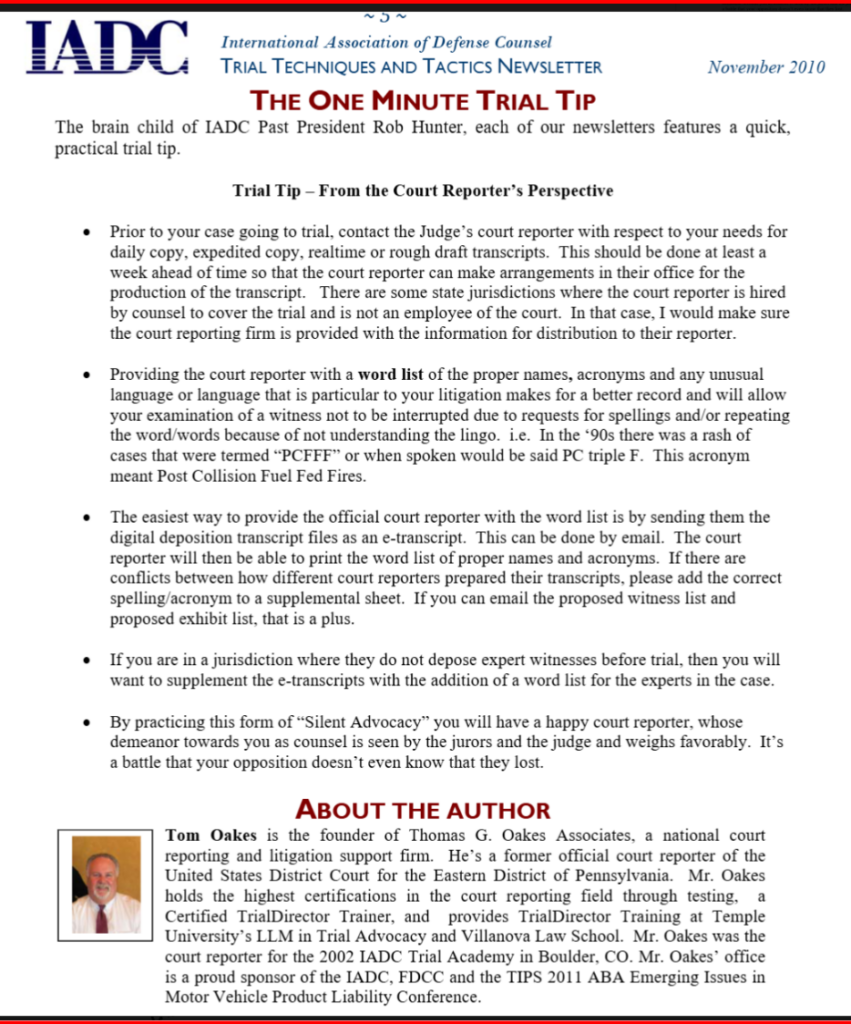
Looking back at this publication, I’m reminded that while courtroom technology has changed dramatically since 2010, the importance of preparation has not. The advice above formed the foundation for many of the courtroom practices I continued teaching throughout my career and remains relevant for today’s trial lawyers.
Trial Preparation Tip: One of the Most Overlooked Ways to Improve the Trial Record
Every trial begins long before the jury enters the courtroom.
During a trial, court reporters routinely encounter:
- difficult medical terminology
- engineering language
- chemical compounds
- foreign names
- unusual corporate acronyms
- highly technical product terminology
Providing the court reporter with a word list, witness names, expert names, anticipated exhibits, and other case-specific information before testimony begins allows the reporter to prepare those terms in advance. One of the first things a court reporter does is build a case dictionary—a customized database of names, places, companies, acronyms, technical terminology, and other specialized words unique to that litigation.
The more complete and accurate the case dictionary, the better the realtime translation, the fewer interruptions during testimony, and ultimately, the more accurate the official transcript.
For example, if a witness refers to PCFFF—spoken as “PC triple F”— the transcript will show it phonetically – not that it is wrong, but if the acronym has already been entered into the case dictionary, the transcript will accurately reflect PCFFF (Post-Collision Fuel-Fed Fires) in the official record. The same principle applies to complex medical terms, pharmaceutical names, engineering components, product model numbers, and industry-specific terminology.
One of the most overlooked aspects of trial preparation is that the attorneys have been living with the case for months—or even years. They’ve reviewed discovery, taken depositions, analyzed expert reports, and become thoroughly familiar with the terminology. The official court reporter, however, has not been part of that process.
That is why even a simple electronic package provided before trial can make a significant difference. Depending on the case, it might include:
- witness and expert witness lists
- a glossary of technical terms and acronyms
- key company and product names
- anticipated exhibit lists
- digital deposition transcripts
- expert reports
- pleadings or other documents containing specialized terminology
Using those materials, the court reporter can build a comprehensive case dictionary before opening statements ever begin. The result is a smoother proceeding, more accurate realtime translation, fewer interruptions to clarify spellings or terminology, and a better official record.
This is what I have long referred to as “Silent Advocacy.” It is one of the countless things an attorney can do behind the scenes that may never be noticed by the jury, yet can significantly improve the quality of the trial presentation and the official record.
Silent Advocacy Series
Preparing the court reporter before trial is an excellent example of Silent Advocacy—the thoughtful, behind-the-scenes preparation, professionalism, and attention to detail that often improve the quality of a trial without ever drawing attention to themselves.
The term “Silent Advocacy” was coined by George J. Lavin, Jr., Esquire, of Lavin, O’Neil, Ricci, Finarelli & Gray, and developed through his work with co-author Chilton Davis Varner, Esquire, of King & Spalding LLP in Atlanta, Georgia. Their groundbreaking work reminds trial lawyers that many of the most effective advocacy techniques occur long before opening statements or closing arguments. They happen quietly—in careful preparation, professionalism, organization, and attention to detail.
Philadelphia Legal News is proud to continue exploring and expanding these timeless principles through our ongoing Silent Advocacy Series, while recognizing the lasting contributions of George J. Lavin, Jr., Esquire, and Chilton Davis Varner, Esquire, to the art of trial advocacy.
→ Explore the Silent Advocacy Series on Philadelphia Legal News
A Personal Observation
During my years as an Official United States District Court Reporter for the Eastern District of Pennsylvania, many of the finest trial lawyers made it a practice to contact our court reporting office before trial. They understood that helping the court reporter prepare wasn’t simply a professional courtesy—it was an investment in creating the best possible record.
Those attorneys would often provide witness lists, technical glossaries, exhibit lists, and digital deposition transcripts well in advance of trial. That preparation paid dividends throughout the proceedings. It reduced interruptions, improved transcript accuracy, and allowed everyone in the courtroom to stay focused on presenting the case rather than stopping to clarify terminology or spell unfamiliar names.
Looking back, those lawyers understood something that remains true today:
Helping the court reporter prepare is one of the simplest—and most overlooked—ways to improve the quality of the official record.
Modern Trial Preparation Includes Technology
Today’s trial lawyers routinely use:
- Transcript review software
- TrialPad
- TrialDirector
- Electronic exhibits
- Cloud document repositories
- Zoom depositions
- realtime streaming
- Synchronized video depositions
- Digital case management platforms
These innovations have transformed litigation.
But none of them replace preparation.
In fact, technology makes preparation even more important because every digital workflow depends upon accurate information from the beginning.
“Silent Advocacy”
One phrase I used in the original article still makes me smile:
Silent Advocacy.
The concept is simple.
When attorneys take the time to help the court reporter prepare, everyone benefits.
Jurors notice professionalism.
Judges notice efficiency.
Witness examinations proceed with fewer interruptions.
The official record improves.
Your opposing counsel may never realize why everything seems to be running more smoothly—but those small advantages often accumulate throughout a trial.
Lessons Learned After Nearly Five Decades
Looking back today, I’m convinced that courtroom success is rarely determined by one dramatic moment.
Instead, it’s usually built through hundreds of small decisions made before anyone enters the courtroom.
Preparation.
Organization.
Professionalism.
Respect for every member of the trial team.
Those principles guided me throughout my career as an Official United States District Court Reporter, founder of a national litigation support company, TrialDirector trainer, educator, and courtroom technology consultant.
They continue to guide the work we publish here at Philadelphia Legal News.
Editor’s Note
When the International Association of Defense Counsel (IADC) published my
“One Minute Trial Tip” in 2010, artificial intelligence, cloud-based trial
presentation systems, electronic evidence management, and remote proceedings were still years away
from becoming commonplace in courtrooms. Yet the lesson I shared then remains just as important today.
Whether attorneys are presenting paper exhibits, using TrialDirector or TrialPad, conducting remote
depositions, or leveraging AI-assisted litigation tools, successful advocacy still begins with
careful preparation, attention to detail, and respect for the integrity of the official record.
I’m especially grateful to the International Association of Defense Counsel for the opportunity to share this trial tip in 2010. Looking back today, it serves as a reminder that while technology continues to reshape litigation, the best trial lawyers still distinguish themselves through preparation, professionalism, and the countless acts of Silent Advocacy that occur long before the jury enters the courtroom.
I hope this article encourages today’s lawyers to think beyond technology alone. The tools will continue to change, but thoughtful preparation, respect for the record, and the quiet habits of outstanding trial lawyers will always remain timeless.
— Thomas G. Oakes
Editor, Philadelphia Legal News
Continue Your Trial Advocacy Education
Continue exploring trial advocacy, courtroom technology, litigation support, and legal technology through these related Philadelphia Legal News resources.
- Silent Advocacy Series – Discover the behind-the-scenes techniques that great trial lawyers use to improve their effectiveness in the courtroom without drawing attention to themselves.
- Trial & Deposition Technologies – Explore courtroom technology, deposition tools, trial presentation software, litigation support, and emerging legal technology used by today’s legal professionals.
- TrialPad: Courtroom Presentation Software Review – Learn how TrialPad helps attorneys organize, annotate, and present digital evidence during hearings, depositions, mediation, arbitration, and trial.
- TrialDirector Trial Presentation Software – Discover why TrialDirector remains one of the legal profession’s leading courtroom presentation platforms for complex litigation.
- Legal Education, Trial Technology & Professional Archive – Browse Thomas G. Oakes’ archive of articles, publications, speaking engagements, and legal technology resources spanning nearly five decades in the legal profession.
Additional Professional Resources
- The Oakes Firm – Learn more about the Philadelphia trial attorneys at The Oakes Firm and the firm’s commitment to representing individuals and families in complex personal injury litigation throughout Pennsylvania and New Jersey.
- International Association of Defense Counsel (IADC) – Learn more about the invitation-only legal organization that originally published Thomas G. Oakes’ One Minute Trial Tip in its Trial Techniques and Tactics Newsletter.
- Temple University Beasley School of Law – Home to the nationally respected LL.M. in Trial Advocacy program, where Thomas G. Oakes has served as a faculty member, teaching TrialDirector and courtroom presentation technology.
- Federation of Defense & Corporate Counsel (FDCC) – Learn more about the FDCC, an international organization of distinguished defense counsel and corporate attorneys dedicated to litigation excellence, professional development, and continuing legal education.
Frequently Asked Questions
What was the International Association of Defense Counsel (IADC) publication?
In November 2010, the IADC published one of Thomas G. Oakes’ “One Minute Trial Tips” in its Trial Techniques and Tactics Newsletter, focusing on courtroom preparation from the perspective of an experienced court reporter.
Why should attorneys communicate with court reporters before trial?
Providing witness names, technical terminology, acronyms, and anticipated exhibits before trial helps improve transcript accuracy, minimizes interruptions, and supports a more efficient courtroom proceeding.
Is this advice still relevant with AI and modern trial technology?
Yes. While AI, TrialPad, TrialDirector, electronic exhibits, and realtime transcription have transformed trial practice, they work best when attorneys begin with thorough preparation and accurate information.
What is “Silent Advocacy”?
“Silent Advocacy” is the concept that thoughtful preparation behind the scenes—including helping the court reporter prepare for technical terminology and witness names—creates subtle but meaningful advantages throughout a trial.
Why does Philadelphia Legal News publish articles like this?
Philadelphia Legal News combines current legal developments with practical insights drawn from decades of courtroom experience, legal technology, and trial practice to help attorneys improve their professional skills.
About the Author — Thomas G. Oakes
Thomas G. Oakes is a 45+ year legal professional in Philadelphia and the founder/editor of PhillyLegalNews.com and PhillyLegalConnect.com. He served for many years as an official court reporter in the Philadelphia Court of Common Pleas and the U.S. District Court for the Eastern District of Pennsylvania, and has worked as a freelance court reporter in state and federal courts for decades.
In addition to courtroom work, Tom is a nationally recognized leader in trial technology. He has trained lawyers, judges, and law students in TrialDirector and courtroom presentation, taught in Temple University’s LL.M. in Trial Advocacy technology curriculum (with special recognition), and has lectured nationally and internationally for organizations including the FDCC and IADC. He also founded the FDCC “FedTech U” program and has instructed in the FDCC Deposition Boot Camp.
Award: Temple University LL.M. in Trial Advocacy — 2013 Faculty Award for “Art of Technology in the Courtroom.”
Tom, prior to his retirement, was the principal of Thomas G. Oakes Associates, a Philadelphia-based litigation-support and trial-technology firm serving attorneys nationwide for more than 33 years.
Disclaimer
This article is for general informational and educational purposes only and does not constitute legal advice. Reading this content does not create an attorney–client relationship. If you need legal advice about a specific situation, consult a qualified attorney in the appropriate jurisdiction.